


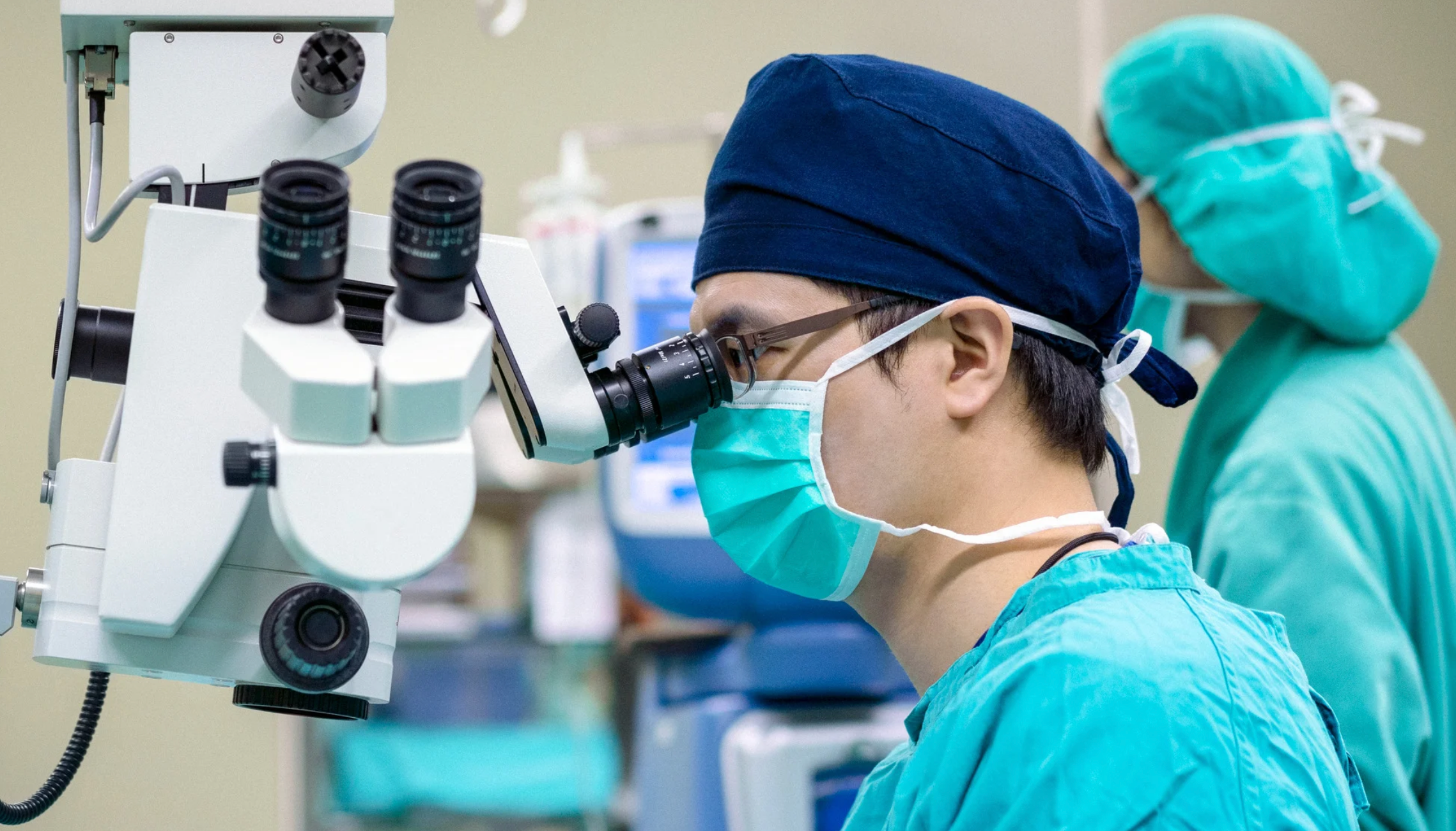

Although this is his first presentation to patients, he certainly recognizes the importance of connecting with them on a day like this. Because not only can the eye patients learn something from his story, but—as a doctor—he can learn a great deal from the patients’ stories, Hötte emphasizes. “And future patients, in turn, benefit from that.” A win-win situation, in other words. Having said that, he goes on to discuss the various situations in which a patient might wear a prosthesis: after an enucleation or an evisceration, or a prosthesis or cosmetic contact lens over the patient’s own eye. Hötte also mentions exenteration, a procedure in which other parts of the eye socket are removed as well, but due to time constraints, he is unable to go into further detail on that.
Enucleation
For a patient with a malignant tumor in the eye, enucleation—that is, the removal of the entire eye—is performed. Hötte uses diagrams to show that the entire eyeball is removed during enucleation, but that the muscles and the mucous membrane covering the eyeball remain intact. The implant used to fill the eye socket is attached to the muscles. The mucous membrane is then closed over the implant. The prosthesis is placed over that. According to Hötte, the goal of enucleation is the complete removal of the malignant tumor. It can then be examined by a pathologist. In the past, enucleation was also performed for a painful, blind eye or an eye that was cosmetically unsightly, but nowadays doctors opt for evisceration in these cases. Hötte refers to this as a “shift” that has taken place among doctors over the past few decades.
Evisceration
This is a procedure that is currently used to treat a painful blind eye or a blind eye that is cosmetically unsightly. Not the entire eye is removed during this procedure, as the sclera and the optic nerve remain intact. The implant is then placed within the sclera. The sclera and the conjunctiva are then closed over the implant, and the prosthesis is placed on top of it. According to Hötte, the major advantage of evisceration is that more tissue is preserved. “And the fewer anatomical changes there are, the better the outcomes,” says Hötte.
Prosthetic over the natural eye
“It’s certainly not always necessary to remove a blind eye that’s cosmetically unsightly,” says Hötte. In such cases, a doctor places a prosthesis over the patient’s own eye, but this is contingent on the patient not experiencing any pain in the eye. Additionally, the eye must have shrunk because it is no longer in use. Only then is there enough space for the thick prosthesis. And tests must be conducted to determine whether the patient still has sensation in the cornea. If that is the case, the mucous membrane must be sutured over the cornea through a simple procedure, because it would then be too sensitive for the patient to wear the prosthesis directly on the eye, explains Hötte. If there is no longer any sensation in the cornea, the prosthesis can be placed directly on the eye.
Cosmetic contact lens
Sometimes there isn’t enough room in the eye for such a thick prosthesis, but even then, according to Hötte, there’s a solution: a cosmetic contact lens. This contact lens is also placed directly on the patient’s own eye and “hides” the unsightly eye. Hötte has clearly summarized the vast amount of information about the various procedures and ways of wearing an ocular prosthesis in a flowchart (see image). He then walks us through the process of preparing a patient for surgery. He discusses the different surgeries and what each entails. Notably, while many doctors insert a so-called “conformer”—a type of plastic cap designed to keep the mucous membranes apart—after surgery, the eye hospital immediately fits a temporary prosthesis. “We believe this helps with early acceptance of a prosthesis,” explains Hötte.
Experiences
He briefly goes over the postoperative factors (poor depth perception, but also what to do if the prosthesis falls out), but then Hötte is mainly curious about the experiences of the people in the audience. The stories mainly revolve around whether or not to keep the prosthesis in at night. Some patients find it uncomfortable to keep the prosthesis in, while others are bothered by having to put it in and take it out constantly. Hötte explains that there’s no one-size-fits-all approach in this area, because every patient’s situation is different. “Everyone should do what feels right.” A man in the audience also mentions that after his surgery, he was not fitted with a temporary prosthesis or a conformer. The patient in question also mentions that he didn’t find the experience pleasant and that the eye socket only started to feel better once the ocularist fitted him with a temporary prosthesis. Finally, Hötte would like to discuss complications following surgery, such as drooping eyelids and persistent pain after an enucleation or evisceration, as well as ongoing studies.
