| post_content |
"""
<!-- wp:post-date {"datetime":"2025-11-26T15:34:00"} /--><!-- wp:heading {"translatedWithWPMLTM":"1"} -->\n
<h2 class="wp-block-heading"><strong>First, a little more about ICE syndrome</strong></h2>\n
<!-- /wp:heading --><!-- wp:paragraph {"translatedWithWPMLTM":"1"} -->\n
<p>ICE syndrome (Iridocorneal Endothelial Syndrome) is a rare eye condition that usually affects one eye, particularly in women between the ages of 20 and 50. It occurs when cells on the inner surface of the cornea stop functioning properly. This can lead to various symptoms: blurred or hazy vision due to fluid in the cornea, changes in the iris, increased eye pressure (glaucoma), and sometimes pain or halos around lights. There is no cure for the syndrome, but treatments such as eye drops, surgery, or a corneal transplant can alleviate the symptoms. </p>\n
<!-- /wp:paragraph --><!-- wp:heading -->\n
<h2 class="wp-block-heading"><strong>Kirsten</strong></h2>\n
<!-- /wp:heading --><!-- wp:paragraph {"translatedWithWPMLTM":"1"} -->\n
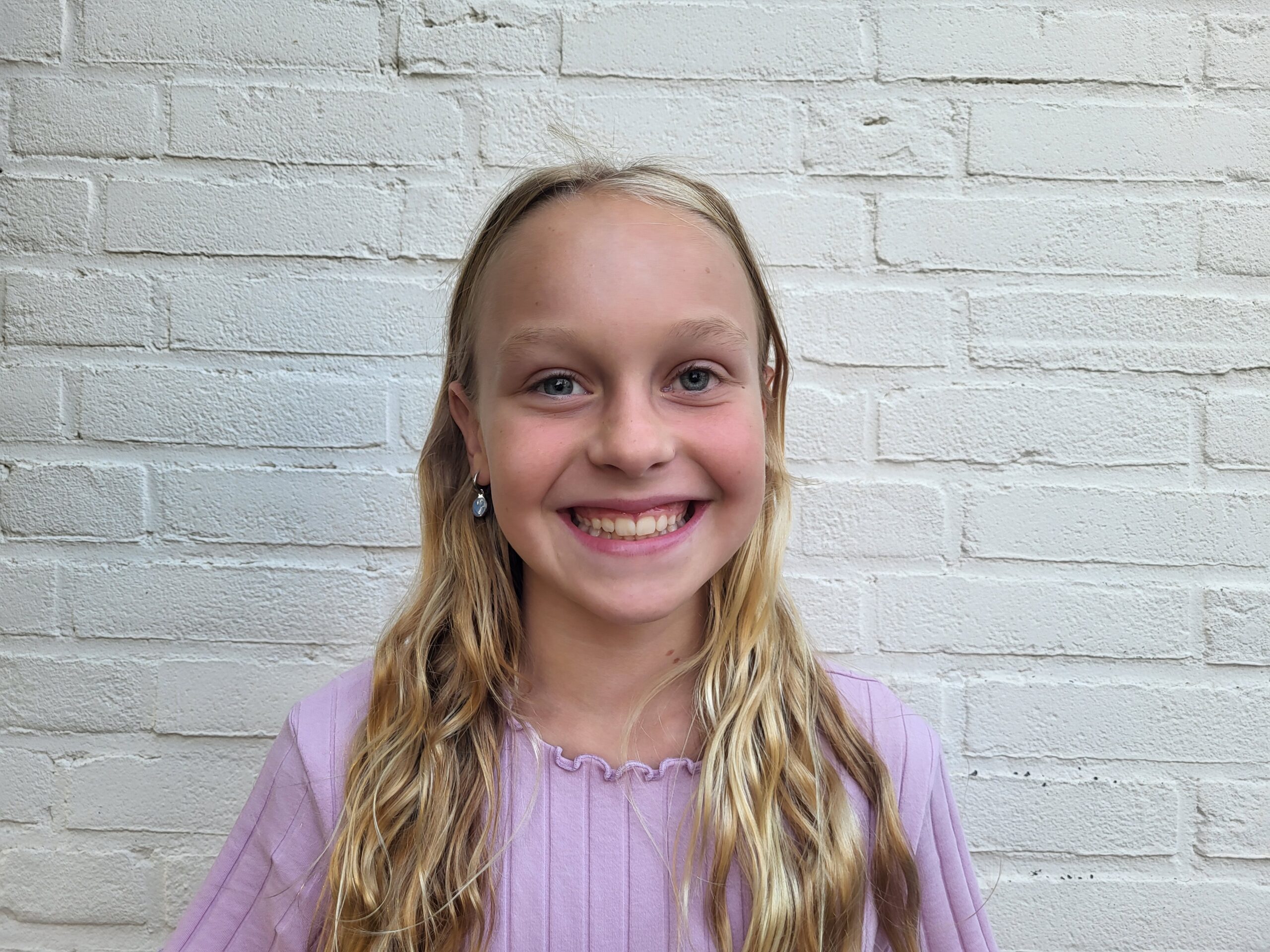
<p>Kirsten (56) lived with her family in Norway, where she worked as an offshore helicopter pilot. She had noticed as early as 2006 that something wasn’t right. “I would occasionally experience a flickering image. I don’t know if that was related to it back then.” In 2011, her symptoms became more serious. She saw halos (rings of light) around streetlights and car headlights, the whites of her eyes slowly turned redder and began to burn, and she occasionally had headaches. Her family doctor reassured her: she had just given birth to her second child, so she must be tired. “So I just carried on with my symptoms,” she says. </p>\n
<!-- /wp:paragraph --><!-- wp:paragraph {"translatedWithWPMLTM":"1"} -->\n
<p>Six months later, things took a turn. “I started getting excruciating, stabbing headaches around my temples.” Her primary care physician was alarmed and immediately referred her to an ophthalmologist. There, it turned out that her intraocular pressure was high—45—and she was diagnosed with acute angle-closure glaucoma. Eye drops didn’t help, and surgery to create a small opening seemed to be the solution. What followed was a years-long series of treatments and surgeries: laser treatments, injections, trabeculectomies with revisions, and drains such as an Ahmed implant and, later, a Baerveldt implant. “Things always seemed to be going well for a while, but after a few months, everything had closed up again due to the ICE cells, and my pressure was high once more.” It affected not only her health but also her family and her work. “You’re not just giving yourself hope, but your employer as well. Going on and off sick leave, the same question kept coming up: ‘What should we do with you?’” </p>\n
<!-- /wp:paragraph --><!-- wp:image {"id":4354,"width":"273px","height":"auto","sizeSlug":"large","linkDestination":"none"} -->\n
<figure class="wp-block-image size-large is-resized"><img src="https://ver-ooginoog.nl/wp-content/uploads/2026/02/Kirsten-683x1024.jpg" alt="" class="wp-image-4354" style="width:273px;height:auto"/></figure>\n
<!-- /wp:image --><!-- wp:paragraph {"translatedWithWPMLTM":"1"} -->\n
<p>It wasn’t until three years later, in London, that she finally received the correct diagnosis: ICE syndrome. Six months later, she had to undergo surgery again. Her vision continued to deteriorate, and her intraocular pressure rose once more. Her career as a helicopter pilot in Norway came to an abrupt end. “We moved back to the Netherlands. It’s amazing what an impact an eye disease like this can have on an entire family’s life.” </p>\n
<!-- /wp:paragraph --><!-- wp:paragraph {"translatedWithWPMLTM":"1"} -->\n
<p>Kirstens’ cornea was also affected by the syndrome. “I had surgery on that several times as well, but it was beyond repair.” She continued to experience pain, and light became almost unbearable. Eventually, the decision became unavoidable: her diseased left eye had to be removed. “At one point, I thought, ‘This isn’t going to get any better.’ The sooner that eye is removed, the better.” In March 2025, she underwent an eye removal and received an ocular prosthesis. </p>\n
<!-- /wp:paragraph --><!-- wp:paragraph {"translatedWithWPMLTM":"1"} -->\n
<p>“Having my eye removed was emotional, but it brought me peace. No more headaches.” Getting used to seeing with one eye takes time. “Seeing depth is difficult, and my balance is different. Sometimes I get pretty dizzy, but the doctors say that will hopefully go away in a year.” The prosthesis looks natural, but she still has to get used to it. Still, the positive feelings prevail. “I step outside and can once again feel the sun on my face. I can enjoy that.” <br/><br/>She remains realistic about the journey she has taken, but above all wants to show that a prosthesis can also give you freedom. “I always thought: if it comes to that, it’s the end of the road. But now I realize: life is getting lighter again.” </p>\n
<!-- /wp:paragraph --><!-- wp:heading -->\n
<h2 class="wp-block-heading"><strong>Ivonne</strong></h2>\n
<!-- /wp:heading --><!-- wp:paragraph {"translatedWithWPMLTM":"1"} -->\n
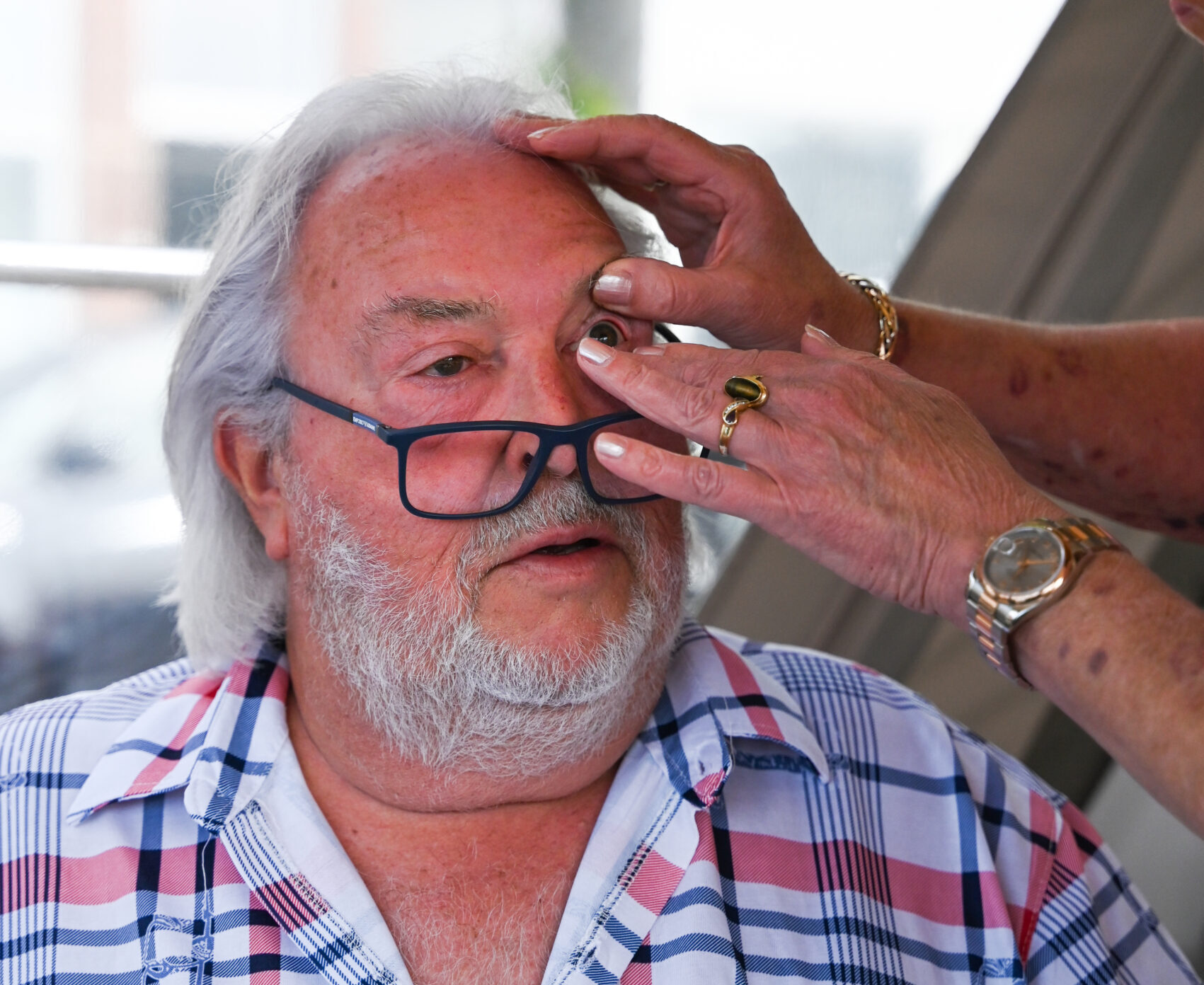
<p>In 2009, Ivonne (64) noticed that something was wrong with her eyes. “As I was biking to work, I suddenly saw all these circular rainbows around the streetlights. It looked cheerful, but I knew something wasn’t right.” Since she had just gotten divorced, she initially thought it was due to stress. Still, she went to the doctor, who referred her to the hospital. There, she got the shock of her life: “The doctor looked into my eyes and immediately said I had a rare disease. I was going to go blind in one eye.” The diagnosis of ICE syndrome brought a lot of uncertainty. For years, Ivonne faithfully went for checkups, but received hardly any information about the condition. “Everything I found online was in English. That made me even more uncertain.” </p>\n
<!-- /wp:paragraph --><!-- wp:image {"id":4353,"width":"275px","height":"auto","aspectRatio":"0.6670050417893276","sizeSlug":"large","linkDestination":"none"} -->\n
<figure class="wp-block-image size-large is-resized"><img src="https://ver-ooginoog.nl/wp-content/uploads/2026/02/Ivonne2-683x1024.jpg" alt="" class="wp-image-4353" style="aspect-ratio:0.6670050417893276;width:275px;height:auto"/></figure>\n
<!-- /wp:image --><!-- wp:paragraph {"translatedWithWPMLTM":"1"} -->\n
<p>Still, she tried to continue her work as a teacher. A few years ago, she developed early-stage cataracts and had her lens replaced. Things seemed stable for a while after that, but in 2023, she began experiencing severe symptoms again. “I had blisters on my eye that burst—it was excruciatingly painful. I was out of commission for months.” Returning to work was tough, especially when the symptoms flared up again. “Sometimes I feel like a ticking time bomb, because I never know when things will go wrong again.” Ivonne is now being treated by a new doctor, who checks on her regularly and is considering surgery. Despite everything, she remains positive. “I really love my job. Sitting at home isn’t for me, so I keep cautiously getting back to work.” </p>\n
<!-- /wp:paragraph --><!-- wp:heading -->\n
<h2 class="wp-block-heading"><strong>Chris</strong></h2>\n
<!-- /wp:heading --><!-- wp:paragraph {"translatedWithWPMLTM":"1"} -->\n
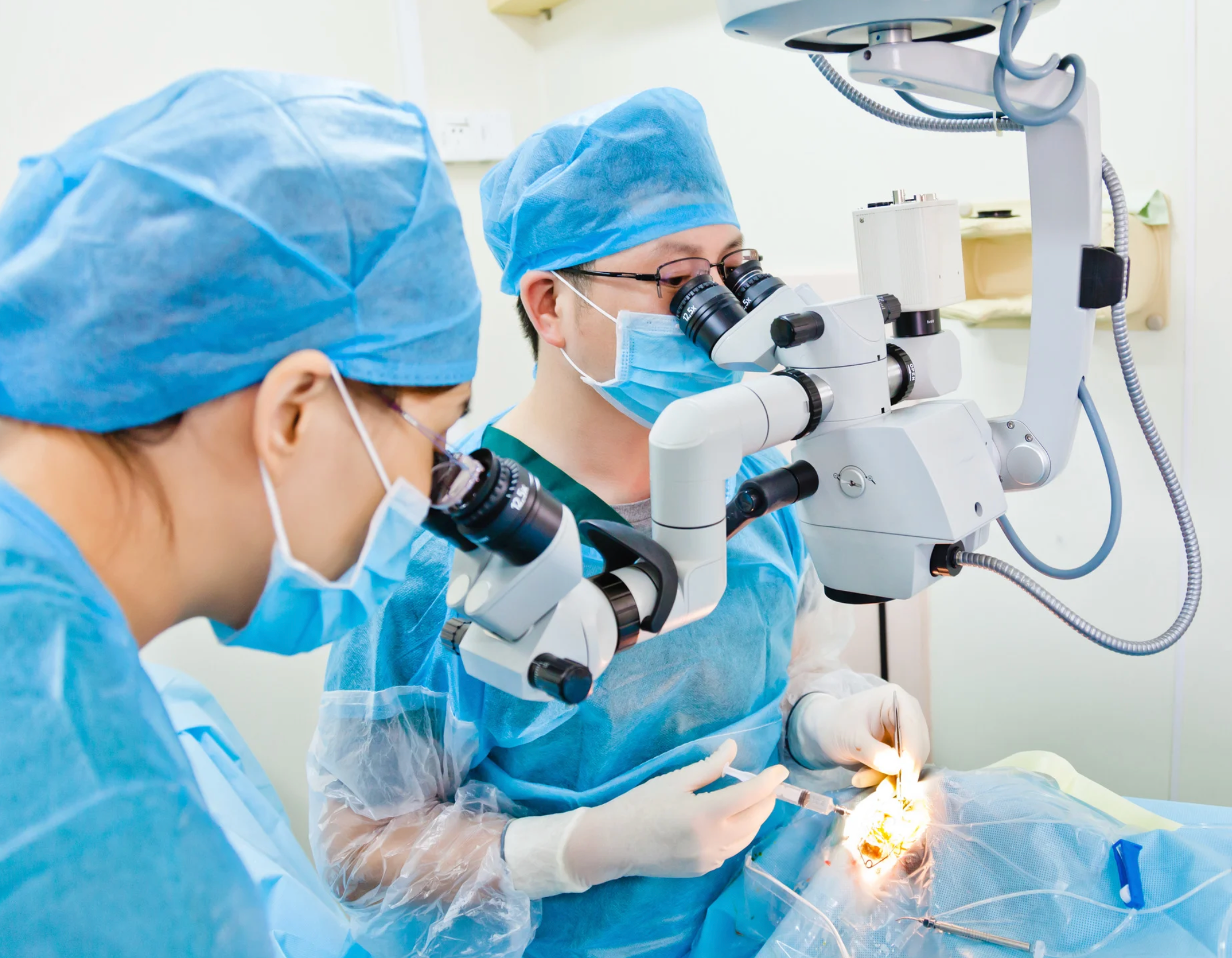
<p>Chris (51) was diagnosed with ICE syndrome in 2014, after years of vision problems. “I started out with a different eye condition, but it eventually turned out that I also had ICE in both eyes. Having the condition in both eyes is very rare and therefore very confusing.” Since then, he has undergone four corneal transplants and procedures to lower intraocular pressure. There is no cure for ICE syndrome, so the condition is untreatable in the long term. “One hospital says that ICE never occurs in both eyes, while another hospital says it is possible. That makes it very difficult for patients, because you get conflicting advice.” </p>\n
<!-- /wp:paragraph --><!-- wp:image {"id":4352,"width":"279px","height":"auto","aspectRatio":"0.6669975186104219","sizeSlug":"large","linkDestination":"none"} -->\n
<figure class="wp-block-image size-large is-resized"><img src="https://ver-ooginoog.nl/wp-content/uploads/2026/02/Chris2-683x1024.jpg" alt="" class="wp-image-4352" style="aspect-ratio:0.6669975186104219;width:279px;height:auto"/></figure>\n
<!-- /wp:image --><!-- wp:paragraph {"translatedWithWPMLTM":"1"} -->\n
<p>The illness had a major impact on his life. Chris had to quit his job as a commercial pilot, something he still misses. “That was really tough mentally. But I’ve also learned to live more in the moment. I used to work 80 hours a week; now I enjoy the little things.” Despite his down-to-earth attitude, the uncertainty remains high. Statistically speaking, donor corneas last for shorter and shorter periods after each transplant. “I realistically assume that my vision will be gone by the time I’m around sixty. That sounds harsh, but it allows me to make plans.” What he hopes for most is greater consistency in medical knowledge in the Netherlands. “It’s concerning that within an hour’s drive, you get completely different perspectives from different hospitals. Our rare condition deserves more research into its causes and treatment options.” </p>\n
<!-- /wp:paragraph --><!-- wp:heading -->\n
<h2 class="wp-block-heading"><strong>Semra</strong></h2>\n
<!-- /wp:heading --><!-- wp:paragraph {"translatedWithWPMLTM":"1"} -->\n
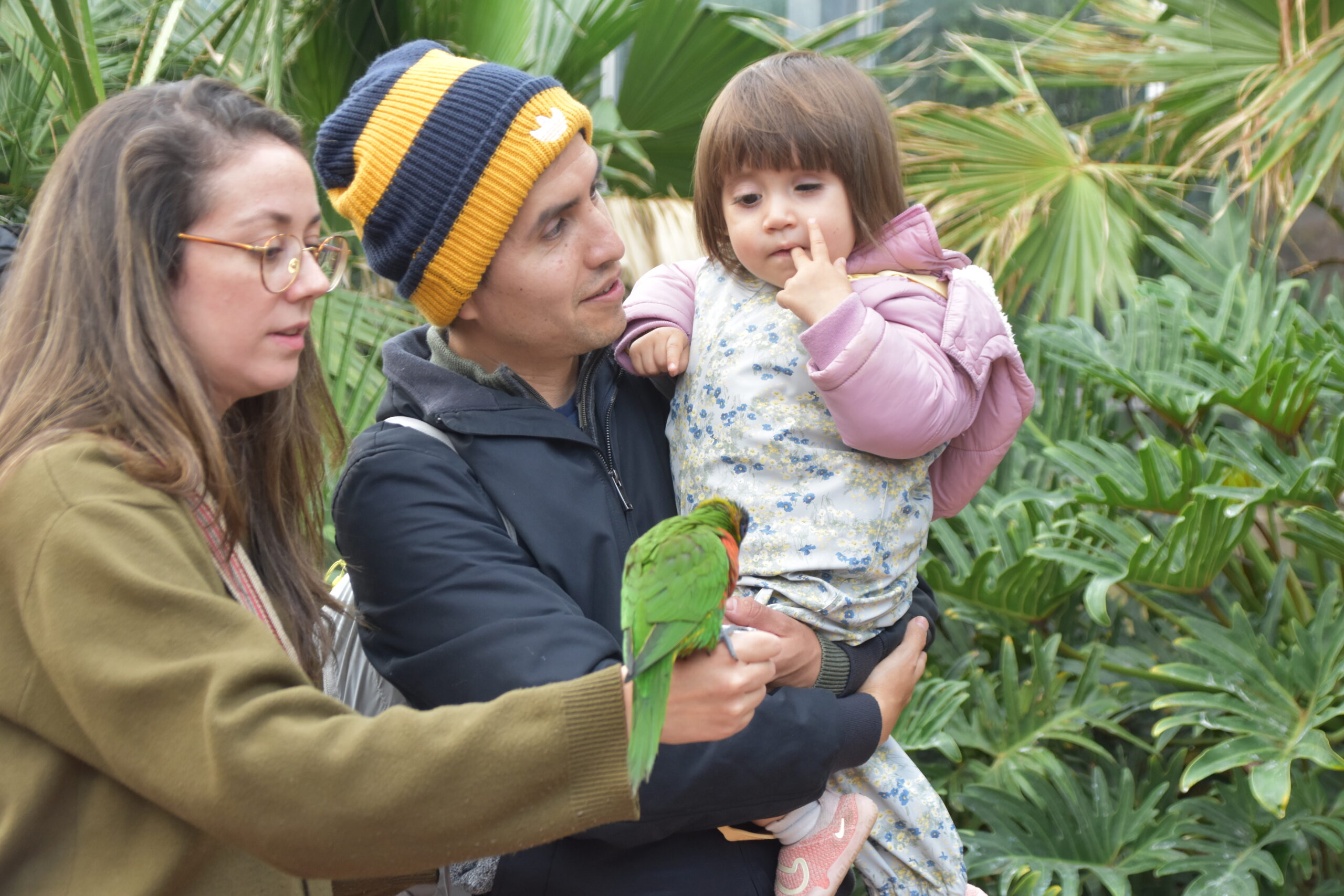
<p>Semra (42) first experienced symptoms in 2022. “I suddenly started seeing halos with my right eye. It didn’t go away, so I went to see my primary care physician. Eventually, at the Rotterdam Eye Hospital, I was told that I have ICE syndrome.” She was first prescribed eye drops, but surgery soon followed, during which a shunt and an artificial lens were implanted. “My intraocular pressure was very high—over 40. I could really feel it, too. Fortunately, after the surgery, my intraocular pressure was low—18 at my last checkup.” Still, her vision isn’t as sharp as it used to be, and she often feels dizzy. Because of this, she can no longer work on a computer. “I used to work 40 hours a week in front of a screen, but that’s too tiring now. Through Koninklijke Visio, I’m getting help to figure out what I can do. I’ve since started my own fun ultrasound agency.” </p>\n
<!-- /wp:paragraph --><!-- wp:image {"id":4355,"width":"270px","height":"auto","aspectRatio":"0.6670025188916877","sizeSlug":"large","linkDestination":"none","translatedWithWPMLTM":"1"} -->\n
<figure class="wp-block-image size-large is-resized"><img src="https://ver-ooginoog.nl/wp-content/uploads/2026/02/Semra2-683x1024.jpg" alt="Photo of Semra" class="wp-image-4355" style="aspect-ratio:0.6670025188916877;width:270px;height:auto"/></figure>\n
<!-- /wp:image --><!-- wp:paragraph {"translatedWithWPMLTM":"1"} -->\n
<p>The hardest part for Semra was accepting that she would only have vision in one eye. “I was under so much stress. After the surgery, I suddenly thought: I can handle this. I’ve accepted it, and that gives me peace of mind.” Staying positive helps her keep going. “I think about my family and my children. If I dwell on fear and sadness, I’ll only make myself unhappy. Of course, I’m afraid that my other eye will be affected too, but I try to let it go.” Fellow patients play a big role in that. “Through hoornvlieswijzer.nl, I found the WhatsApp group with others in the same situation. The others have really supported me, especially when I was afraid of the surgery. I’m very grateful for that.” </p>\n
<!-- /wp:paragraph --><!-- wp:heading {"translatedWithWPMLTM":"1"} -->\n
<h2 class="wp-block-heading">Read more</h2>\n
<!-- /wp:heading --><!-- wp:paragraph {"translatedWithWPMLTM":"1"} -->\n
<p>Would you like to learn more about ICE or connect with others who have this syndrome? Then visit the website hoornvlieswijzer.nl </p>\n
<!-- /wp:paragraph -->
"""
|