


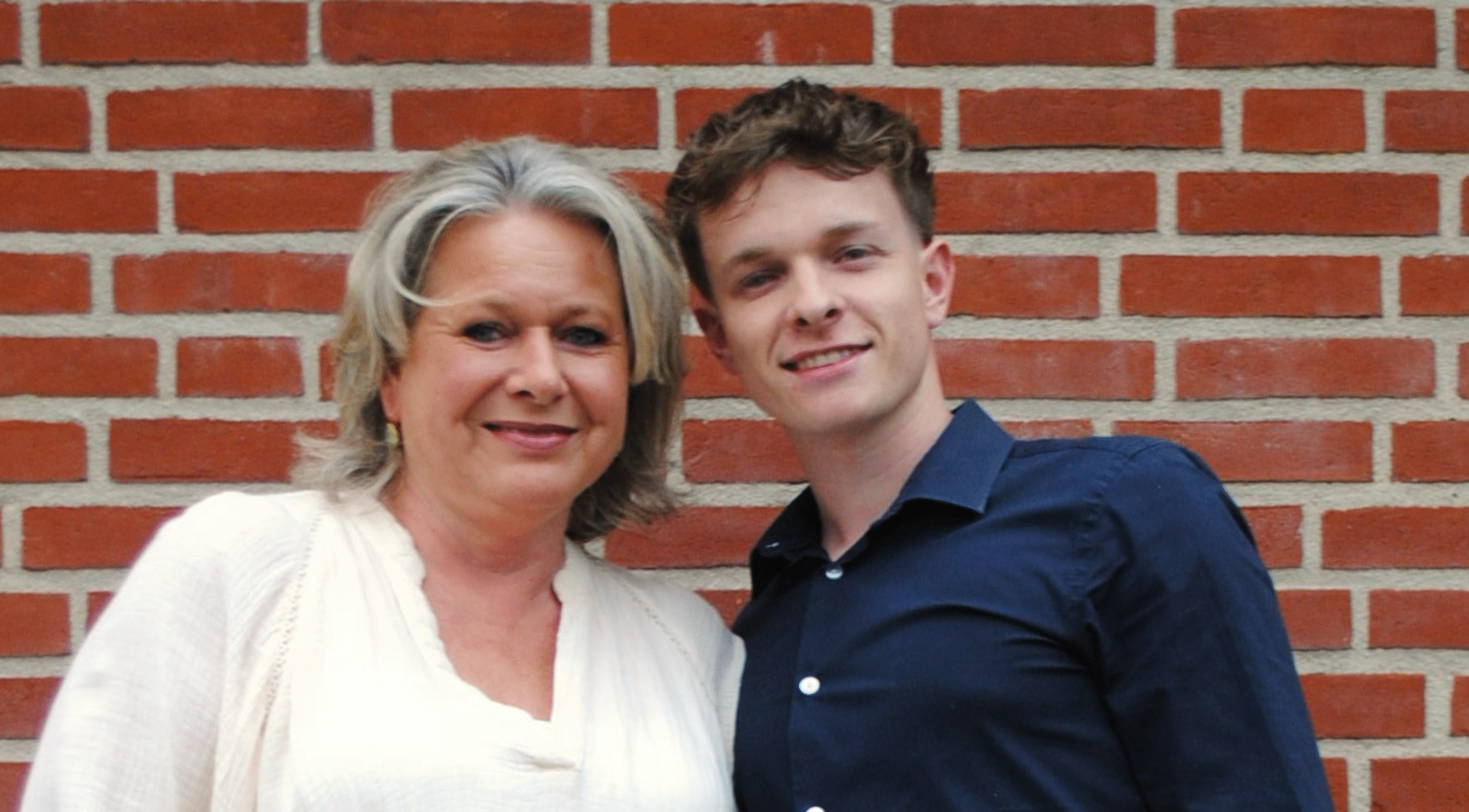

Maarten:
“I was given a lot of freedom growing up. ‘Go ahead and do it, test your limits,’ my parents would say. And if there was something I might not be able to do, I’d want to try it all the more just to prove them wrong. Yeah, I do all kinds of things, even when my mom tells me I shouldn’t. Like the motorcycle license I’m working on right now.”
I’ve never really had any problems with depth perception. When I play ping-pong, I miss the ball just a little more often than others. Tennis, on the other hand, goes well. Though it could also be that I’m better at one than the other. The only thing I might be limited in is watching 3D movies. I sometimes hear that people get headaches from them, so I wonder if it’s really that bad? I’ve never seen with both eyes, so I don’t know what I’m missing.”
Every now and then, Maarten gets a comment about his prosthesis: “They notice something’s different, but they don’t know what it is. Then they ask if my eye is infected, for example. I take it in stride or make a joke.” Maarten gives the example of a recent time he was at the golf course with his class. When he was instructed to position his left eye directly over the ball, he responded with a laugh: “I’m lucky I still have it!”
Maarten has a lot of discharge from his eye socket: “I take the prosthesis out three times a day to clean it. So it takes up quite a bit of my time. We’ve been told that because the prosthesis rubs against the small eyeball, it produces more mucus. But anyway, if that’s all there is to it, I can live with that.”
“I just turned 21 and am living life to the fullest. I really have my parents to thank for that!”
Maya:
Maarten was born via C-section, which turned out to be a blessing in disguise. Because he had to stay in the hospital with his mother for a few days, it was quickly discovered that something was wrong with his right eye. “You become the mother of a beautiful, healthy little boy, and suddenly it turns out something isn’t right,” Maya explains. Maarten was diagnosed with microphthalmia, an underdeveloped eye. “It didn’t take too long before we got answers to our questions. After the initial shock, I never worried about it too much. But you do talk to each other about the future: what he can do, and what he can’t.”
The first visit to an ocularist was intense. “Maarten was just a tiny two-month-old baby, and they put an adult prosthesis in his eye socket. Of course, that didn’t go well at all.” After a few weeks, they ended up seeing ocularist Frédérique Bak, who has a lot of experience with young children. It felt right right away. When Maarten was three months old, he received his first eye prosthesis. Maarten has an underdeveloped eye on the eye muscle that the prosthesis covers. “We replaced the prosthesis very regularly as he grew, to minimize the risk of facial asymmetry. That worked out very well.” “We’re very grateful that Maarten also has a healthy eye. That’s something we’ve always instilled in him: Focus on what you do have. You can live a full life with just one eye. He can do anything, and he’s shown that from a very young age. That gave us the confidence we needed.”
