


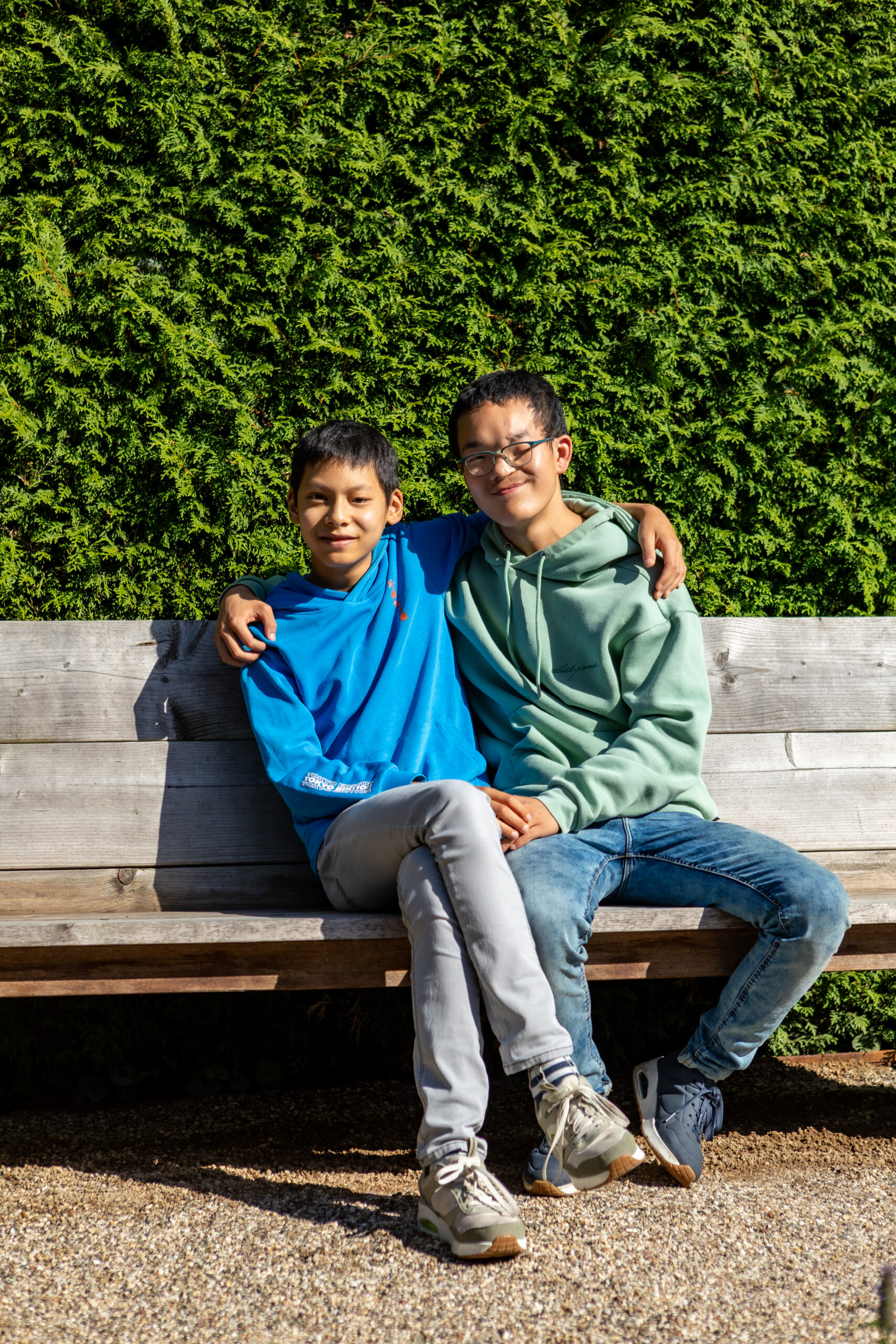

Names: Guo and Xuan Liebrechts
City: Apeldoorn
Condition: Microphthalmia and Anophthalmia
When Natalie and Peter began the adoption process, they deliberately chose China. Not only because the country appealed to them, but also because they were open to adopting a child with a medical condition. In China, so-called “special needs” children are more often eligible for adoption, and they wanted to make a difference in that area. “Together, we very deliberately drew up a list of conditions we were open to,” Peter explains. “First, we each considered it separately, then together. And then you naturally start asking questions like: Can we handle this? Do we want this? What’s right for our family?” Ultimately, they chose a disability that’s visible—such as an eye condition. Natalie: “We thought: we can teach our children to live with that.”
Both boys came to the Netherlands when they were 2 years old—and, not entirely by coincidence, with the same type of condition. “That was actually quite convenient,” Natalie laughs. “We’d all go to the checkups at the hospital together.” Sometimes things went a little too smoothly: “We once accidentally put the wrong eye prosthesis in the wrong child,” Peter recalls with a grin. Xuan no longer wears a prosthesis—his eye socket doesn’t tolerate the material well—and Guo is also choosing more and more often to leave his out. “We let them decide for themselves. They have to feel comfortable with it.” Their parents especially notice how valuable it is that the boys see themselves reflected in each other. “They don’t have to explain anything. They just understand each other.”
Allergy
Xuan’s treatment began intensively: Because he also has a cleft lip and palate, he was referred to the craniofacial team in Rotterdam. There, they began stretching his eye socket using small, gradually increasing beads. “It started with a very small bead that was placed in the eye socket,” Natalie explains. “Then they sealed his eyelid shut with skin glue so the bead could apply pressure and draw in fluid. I really didn’t like that.” Ultimately, Xuan turned out to be allergic to that adhesive, and other methods—such as an implant behind the mucous membrane—didn’t work as hoped either. Xuan hasn’t worn a prosthesis for about three years now, but the years of effort have resulted in better facial symmetry than he had at the beginning.
The fact that Xuan and Guo have Asian eyes certainly played a role in their ability to wear an eye prosthesis. Peter explains that, in Asian people in particular, the lower eyelid can curl inward more easily, causing the eyelashes to press against the eye or the prosthesis and cause irritation. Natalie adds: “In Xuan’s case, there was little space in the eye socket, and eventually the mucous membrane could no longer tolerate the prosthesis.” That made it complicated: as a parent, when do you decide to stop a treatment, and to what extent do you let your child have a say in the matter? “It’s his body, but he also needs us for decisions like that,” says Natalie. After much discussion, they ultimately decided together that he would no longer wear the prosthesis. That was the best choice at the time.
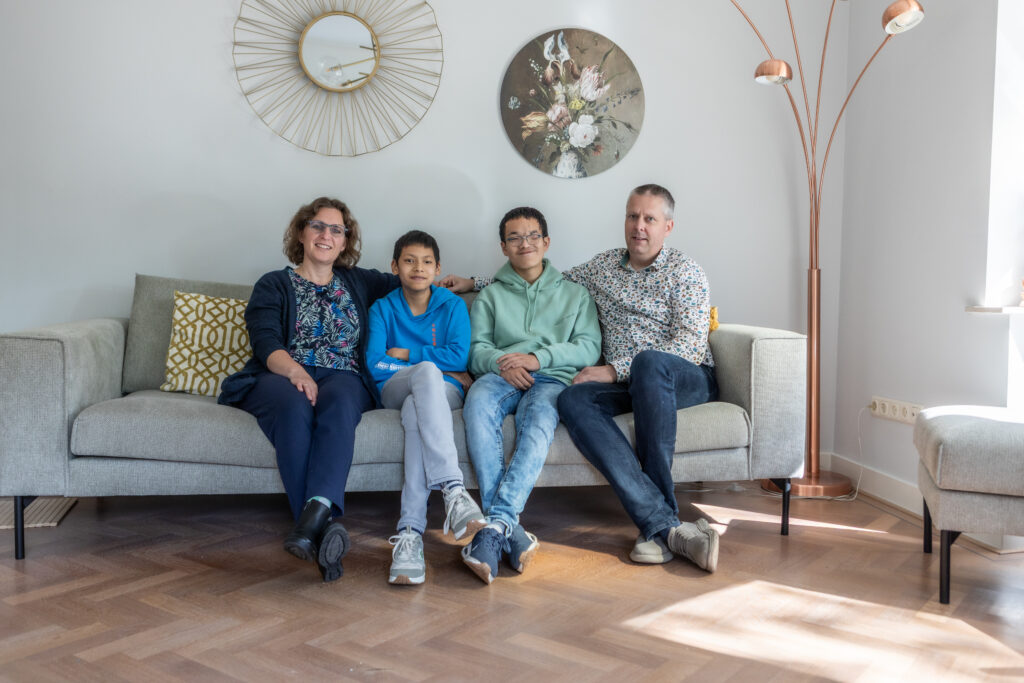
Natalie and Peter haven’t specifically sought psychological help, but they are aware of how important it is to process their experiences and talk about them. “In the beginning, we did attend the Family Days organized by OOG in OOG,” says Natalie. “You find a lot of comfort in that, especially when you don’t know much yet.” Because their children were adopted with a known special need, the situation didn’t come as a shock—unlike for parents who are suddenly confronted with a condition after birth. “We knew what we were getting into, even though there’s always some uncertainty,” says Peter. They didn’t feel they needed additional professional help: there’s a lot of open communication within the family, there’s room for sadness, and the boys are learning to accept their eye condition at their own pace. “At one point, Xuan just said, ‘This is who I am; I’ve embraced it,’” says Natalie proudly.
Fighting a Dragon
Although Xuan and Guo stand out because of their appearance—as Asian boys with a visible eye condition and Dutch parents—they have fortunately experienced very little actual bullying. They’ve actually never been bullied at school, something their parents attribute to their openness and self-confidence. “They’ve given presentations about it and just explained what’s going on,” says Natalie. “That really helps.” At camp or in new groups, they sometimes get curious stares or questions, especially from children—but they usually don’t mind. In fact, they’ve learned to take it in stride. Xuan: “Back when someone used to ask what was wrong with my eye, I’d just say, ‘I fought a dragon.’” They find it more annoying when people stare without saying anything. “Just say it—at least then I’ll know what you’re thinking,” Xuan says matter-of-factly.
The idea to participate in this interview didn’t come solely from the parents; it was also discussed with the boys. “We actually thought it was a good idea right away,” says the oldest son. “Because you usually only hear the difficult stories. But there are also people who manage to live with it pretty well—you just rarely hear about them. I hope that when others read our story, they’ll think: Hey, so it can be like this, too. Maybe that will give them a little hope.”
Give it a try
Sports play an important role in Xuan and Guo’s lives. Despite their visual impairments, they are both active and try their hand at all kinds of activities—from track and field and field hockey to gymnastics. “Your brain learns to cope with it,” Guo says matter-of-factly. They even try fast-paced ball sports like table tennis at the campground; it helps to stand close to the table or use tricks to better judge distances. Xuan has been an avid gymnast since he was seven and competes in all events without any problems. Guo does track and field. The most important thing: they don’t let anything hold them back. Their parents are proud of how they come up with solutions on their own, push their limits, and, above all, enjoy life.
