



I never had any trouble seeing with just one eye. I didn’t know any better. But I was ashamed of it. For example, as a child, I wanted to serve in the military. But when I was deemed unfit for service at age 18 because of my eye, it actually worked out for the best. Sometimes I wished I could get a“bionic eye.”This was inspired by a (fictional) TV series from the 1970s starring “The Six Million Dollar Man.” The show was about an astronaut who had been in an accident and was given supersonic body parts, including“a super eye.”
I don’t understand what I don’t see
The question of what seeing depth actually is crosses my mind from time to time. I’ve always had a sense of depth. But what would I actually be missing? I don’t understand what I don’t see that people with two eyes do see. When I look at a photo, isn’t that the same two-dimensional world as the one I see around me? And actually, I’m not even aware that I’m looking with only one eye.
Interest in photography
I think I was about 12 years old when I first became interested in photography. My mother took photos; she had learned about photography during her training to become an X-ray technician. My first camera was a Lubitel 2 from the USSR. It was a medium-format camera that used a roll of film for 12 exposures. It was a complicated piece of equipment. I had to hold the camera against my stomach and look down into it from above, and everything was reversed. Left was right, and vice versa. The camera didn’t have a light meter, but I’d learned a bit about shutter speed and aperture, so I had a general idea of how to set it up. To make a long story short: I was interested in photography, but it didn’t become my professional career.
One eye, a thousand images
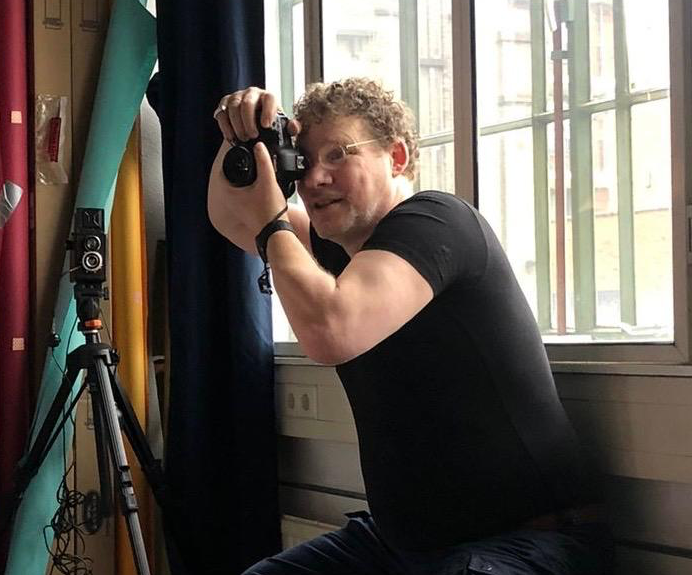
People sometimes ask me if it’s difficult to take photos with just one eye. I really don’t know if it’s any harder. Maybe it just comes more naturally to me to translate the images I see in my head into a photo that lacks depth. It’s actually the same thing. I can’t look through the viewfinder with one eye and keep scanning my surroundings with the other eye past the camera. I am, however, aware that I have to look very closely. Sometimes I’m suddenly surprised because something suddenly appears in the viewfinder—and thus in my field of vision with my sighted eye. I wouldn’t have noticed it with my blind eye.
I really enjoy being able to take photos as a volunteer for OOG in OOG. We share something special: we both have an ocular prosthesis. I’ve taken over the baton from my fellow photographer (and ophthalmologist) Marina Marinkovic. You can also see her beautiful photos on the website and in the magazine. How cool is that?
If you’d like to see what else I photograph besides the work I do for OOG in OOG, please check out my website. ”
