


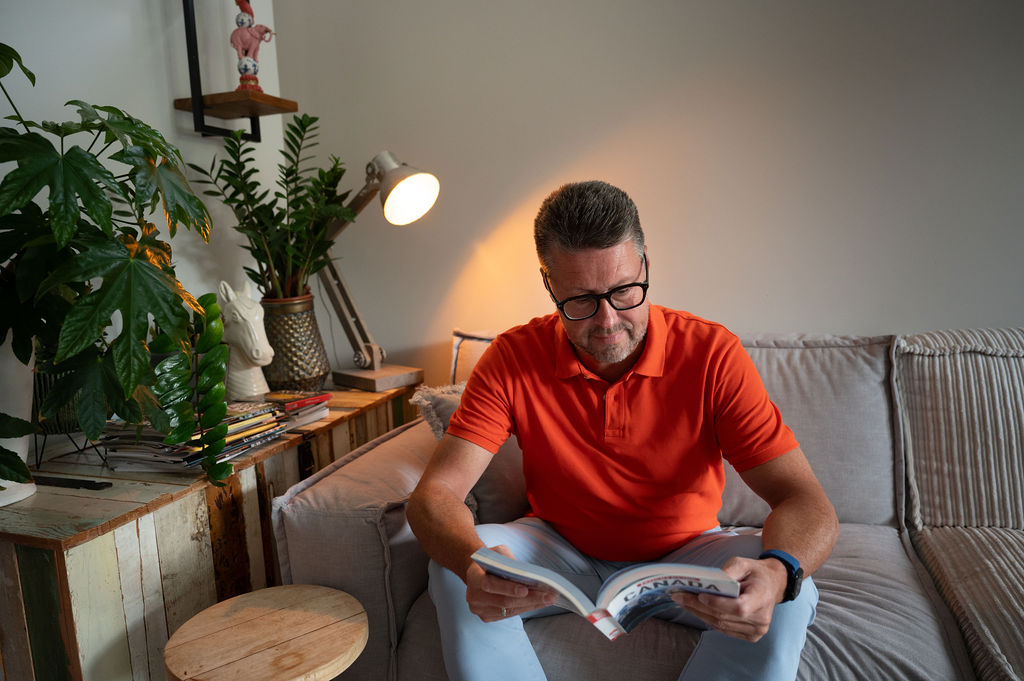

Light has a significant impact on our perception. Therefore, if you rely on one eye, it’s important to consider the lighting in places such as your home or workplace. Determining the right indoor lighting depends on the individual and the situation. The points below can help you critically assess and improve your lighting situation.
Make sure there is enough light
Start by providing sufficient general lighting. This ensures that everything is evenly lit and that there are as few shadows as possible. This is necessary to be able to see the entire space, such as a room. When the differences in light intensity within the space are less pronounced, your eyes tire less quickly. Many people with low vision need more light than people with normal vision. In addition to reduced vision, age also plays a role. As people get older, their need for light often increases.
By installing additional lights in your home and/or replacing light bulbs, you can increase the brightness in your home and prevent dark spots. You can increase the brightness by using light bulbs with a higher luminous flux (= more lumens). Lamps with a large base can provide 600 lumens or even 1,600 lumens.
Think about reducing your workload
Make sure you have extra lighting when you’re working on a task:
Read
Turn on a floor lamp or a desk lamp when you’re reading on the couch or at the table.
Looking inside cabinets
Make sure you have cabinet lighting or a flashlight.
Preparing Food
Make sure the countertop is well-lit, such as with an LED strip under the kitchen cabinets or pendant lights if there are no upper cabinets.
Making Music
Make sure you have a lamp that illuminates sheet music.
Self-care (manicures, applying makeup, shaving, etc.)
Make sure there’s extra light by the mirror, or use a separate mirror next to your desk lamp. Make yourself as comfortable as possible. You might be able to read without an extra task lamp, but reading requires less effort if you turn on a light. During the day, you can also take advantage of natural light by sitting near a window. You’ll benefit most if you position yourself so that the light doesn’t shine directly into your eyes but does shine on your hands.
Make sure the light source doesn’t shine in your eye
Light that shines directly into your eyes impairs your vision and causes unnecessary fatigue and irritation. People with eye conditions, in particular, can be greatly affected by this. You can prevent this type of annoying light by properly shielding the light source. The lamp should be positioned so that the light source is not visible. The shade should not have any holes and should not be transparent.
Prevent Glare
Wherever you’re staying or performing a task, it’s important to avoid having bright, reflective surfaces in your field of vision. Such surfaces could include a window, a tabletop, or a white sheet of paper. You can prevent glare from daylight by sitting with your back to the window or by using effective sunshades or light-blocking curtains. You can reduce distracting glare from white paper by adjusting the position of the lamp or by holding the paper at an angle.
Ensure even light distribution
When you look up from your work, it’s nice to be able to see your surroundings as well. When the light at your workstation is bright and the surrounding area is dimly lit, it feels as if you’re looking into a dark hole when you look up. Your eyes need time to adjust to this. For people with low vision, this adjustment can take a long time, which is why it’s important that there aren’t too many differences in lighting levels within a room.
Significant differences in lighting levels can usually be avoided by using indirect lighting.
This often involves lighting that shines directly onto the ceiling, but it can also work just as well when directed at the wall. To prevent bright reflections from light sources or to avoid light pollution, it is important that:
- The fixtures emit light exclusively upward and are closed at the bottom.
- There is no direct line of sight (you cannot see the light source).
- Do not place the light fixture too close to the wall (to avoid an annoying bright spot on the wall).
Make sure the light is adjustable
It’s nice to be able to adjust the lighting to suit the task you’re doing. For example, you might want less light when eating and more light when reading the newspaper. You can choose lamps with dimmers, smart lighting, or use multiple lamps.
Take Advantage of Smart Home
With smart devices—in this case, smart lights—you can use technology to further optimize the lighting in your home. For example, you can adjust the light from the bulbs based on the time of day, or control the lighting with your voice. You’ll need the appropriate equipment for this, as well as technical knowledge to set it up.
Exercises
Sometimes, even with good lighting, your eyes can still get tired. In that case, there are a few things you can do:
- Blinking: Blinking about 20 times helps keep your eye better hydrated. Your eye will be less likely to dry out and will feel more comfortable.
- Roll your eyes: Look all the way to the right without moving your head. Then roll your eyes up, then to the left, and then down. Do this about 10 times, both clockwise and counterclockwise.
- Make it dark: Place your hand over your good eye, without pressing on it. Let it be completely dark for 1 minute. This is very relaxing for your eye.
- Look out the window: Stick a Post-it note on the window and alternate your gaze between the note and something outside. If you’ve been staring at a computer screen for a long time, this is very relaxing for your good eye.
- The 20-20-2 rule: After 20 minutes of close-up work, take a short break to look into the distance for 20 seconds, and spend at least 2 hours a day outdoors.
Do you still have symptoms?
Of course, you should take steps to prevent problems from developing in your good eye as well. Do you have a tired, dry, or itchy eye? See your family doctor or ophthalmologist. It’s very important to prevent inflammation or damage to your good eye.
Do you have any questions?
You can contact Koninklijke Visio with any questions you may have about lighting. The occupational therapists at Koninklijke Visio will help you with tips and practical advice. Send an email to kennisportaal@visio.org, or call 088 585 56 66.
