



My backyard in the city is always bustling with birds. It helps that there’s a pond in the yard, that there are a few cluttered corners where I don’t clear away the leaves, and that I make sure there’s always something for them to eat. In the winter, I scatter (bread) crumbs and birdseed, hang some suet balls, and put out a jar of bird peanut butter. I place pieces of apple here and there, and for the greenfinches, finches, siskins, and various types of titmice, there’s a feeder with (unhulled) striped sunflower seeds. On winter days, the birds fly back and forth all day long, and when dusk begins to fall, it really gets busy. All the birds rush over quickly to grab a bite to eat before nightfall.
In the morning, as the light begins to break, things get busy again because, after the long, cold winter night, it’s time to eat once more. The greenfinches, finches, and siskins arrive in small groups all at once, fluttering and squawking as they squabble with one another. The house sparrows are also always huddled together in cozy groups and communicate with each other by chirping at a deafening volume. The various titmice keep more distance from one another, but constantly chirp back and forth in a question-and-answer pattern.
Three little brown birds
Three small brown birds are hard to tell apart by their calls, and because they’re so small, they’re often hard to spot—especially with just one eye. The smallest is the wren; it’s also called “Little Jantje.” It’s a tiny brown ball of a bird with an upright tail. It hops back and forth very quickly. For such a small bird—barely 9 cm long—it makes an astonishing amount of noise. Its song is beautifully clear, and as it hops, it makes a shrill, metallic sound that clicks rapidly in succession: tek-tek-tek-tek. The dunnock is also brown, but speckled, and has a blue-brown head. It doesn’t hop like most birds do, but runs back and forth on its short little legs. Chances are, if you see it running, you’ll think it’s a little mouse. In between all that running, the dunnock whistles a clear, metallic song. The largest of these three birds is the robin, which you’ll recognize immediately by its bright red breast. Identifying them by sound is trickier, because its ticking “tek-tek-tek-tek” call sounds a lot like that of the wren, and its loud, shrill song—which it uses to warn intruders in its territory—bears a striking resemblance to the song of the dunnock. The robin is the first little bird I see when I open the curtains in the morning. It sits on a post or on the garden table and looks at me questioningly, as if to say, “I was the one singing—am I getting something to eat now?” I reward him with a handful of birdseed!
Most Famous City Bird: Blackbird
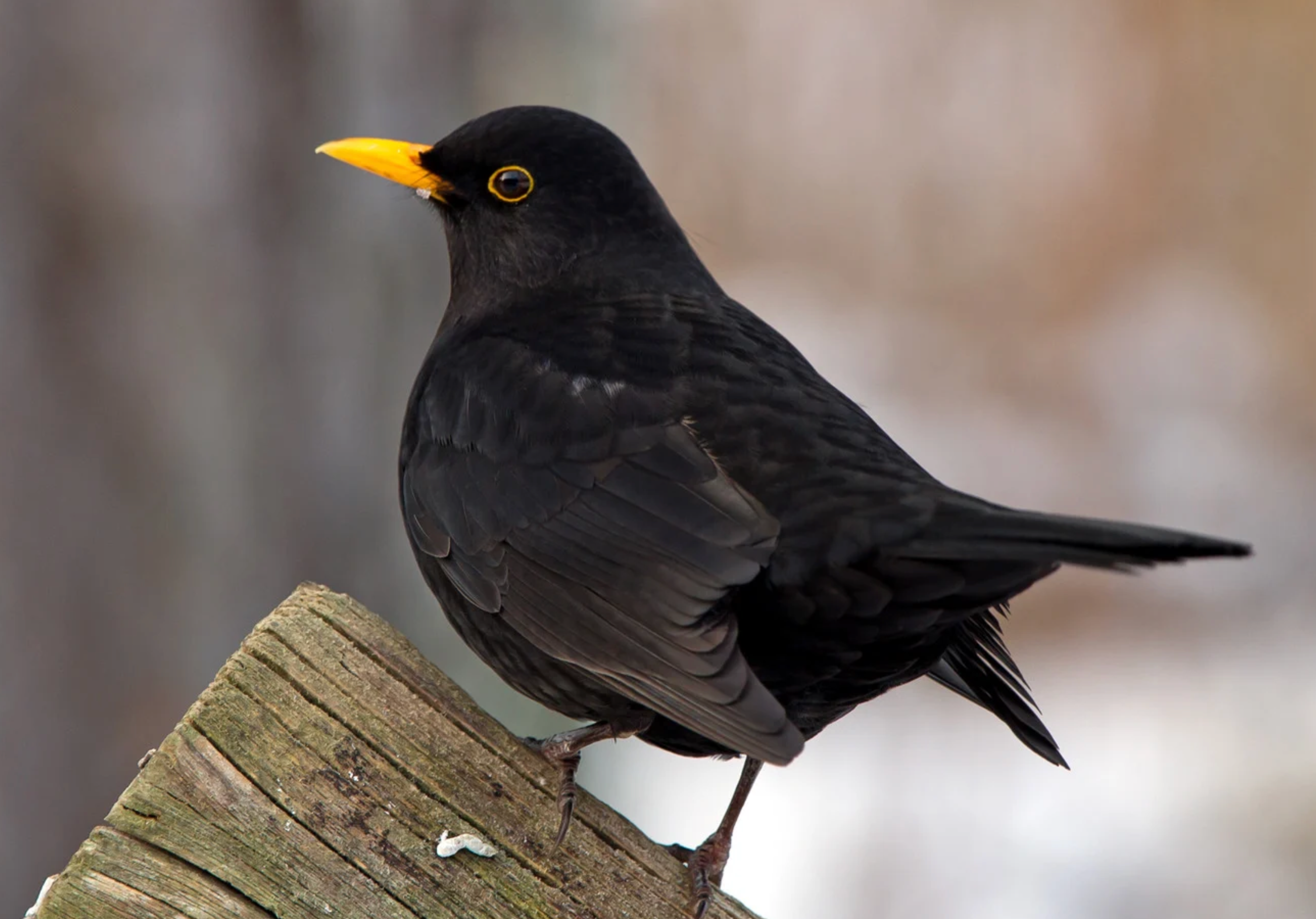
The best-known urban and garden bird is probably the blackbird; the English call it “Blackbird.” That name fits perfectly for this black bird with its orange beak. Early in the morning or at dusk, it sits in a tall tree or on a chimney, singing beautifully. Every blackbird has its own repertoire. In the trilling, rolling song of the blackbird in my garden, I recognize melodies from classical music. When I walk through the city center, I often hear a blackbird whose song sounds a lot like the music of the Beatles. I’ll pause for a moment to listen and watch. Usually, people walk past me without hearing or seeing it, but sometimes they stop to look and listen too. Recently, a man and a woman also paused for a moment, and the woman whispered to the man, “Blackbird!” They walked on, laughing, and the man whistled the Beatles song that I’d also heard in the blackbird’s song—“Blackbird.”
Anita Hol-Bubeck
