


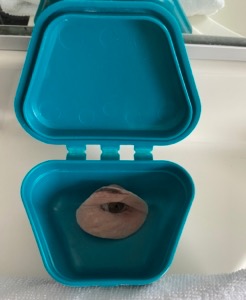

To avoid having to look at that staring gaze, I snap the lid shut. At that moment, I really think I hear a little voice calling out from inside the container: “Write about me!” That’s actually a pretty good idea, because I haven’t done that very often. I’ve written once or twice about forgetting to put on the prosthesis (but that hasn’t happened since I put a mirror in my hallway). I also wrote about how the prosthesis has become such a part of me that I feel a prick when it’s lying in the Biotex container. And I also mentioned that dogs and children don’t look at my still, fake eye, but focus their gaze on the one moving eye.
Epithesis in a washcloth
Something I hadn’t written about before was the first time I saw a real prosthesis in person. That was during a consultation with the surgeon who would be performing the eye removal surgery. He explained once again that the surgery and radiation therapy offered a high chance of a cure. He also mentioned that after the treatments, I should be able to live as normally as possible. That’s why two implants were placed in the eye socket during the surgery, onto which an epithesis could be clipped. “An epithesis—what is that?” I wondered. The surgeon apparently sensed my confusion and asked, “Would you like to see an epithesis?” He then pulled a washcloth out of the pocket of his white coat, which contained an epithesis with a little blue eye. I must have looked at the thing in surprise—perhaps even bewilderment—but certainly with emotion. Meanwhile, I wondered what on earth I was supposed to do with it. The doctor waited quietly and patiently for my reaction. In the end, my sense of humor got the better of me. I handed the artificial eye back and said, “Then put a brown one in there instead of this blue one—it’ll match my other eye better!” The doctor laughed with relief!
A wonderful result
Once my eye socket had healed enough, the preparations began: first, an impression of the eye socket was taken. It didn’t hurt, but it wasn’t a pleasant experience either. Cold, chewing-gum-like stuff in my eye socket while I couldn’t see a thing because my face was covered. But it had to be done. The impression was needed to make the plaster model for the prosthesis. With the patience of a saint, the prosthetist matched the color of the epithesis, painted the brown eye, and sculpted the epithesis to fit me perfectly. The result was beautiful—a work of art! It took some getting used to seeing myself in the mirror with one eye that moved and one that didn’t. The days of bandages and black eye patches were over.
Wearing an epithesis will never feel completely normal, but the promise that I would be able to live as normally as possible has certainly been fulfilled. Back then, I could never have imagined that the staring brown eye in the epithesis would become a source of inspiration for a column.
Anita Hol-Bubeck
