


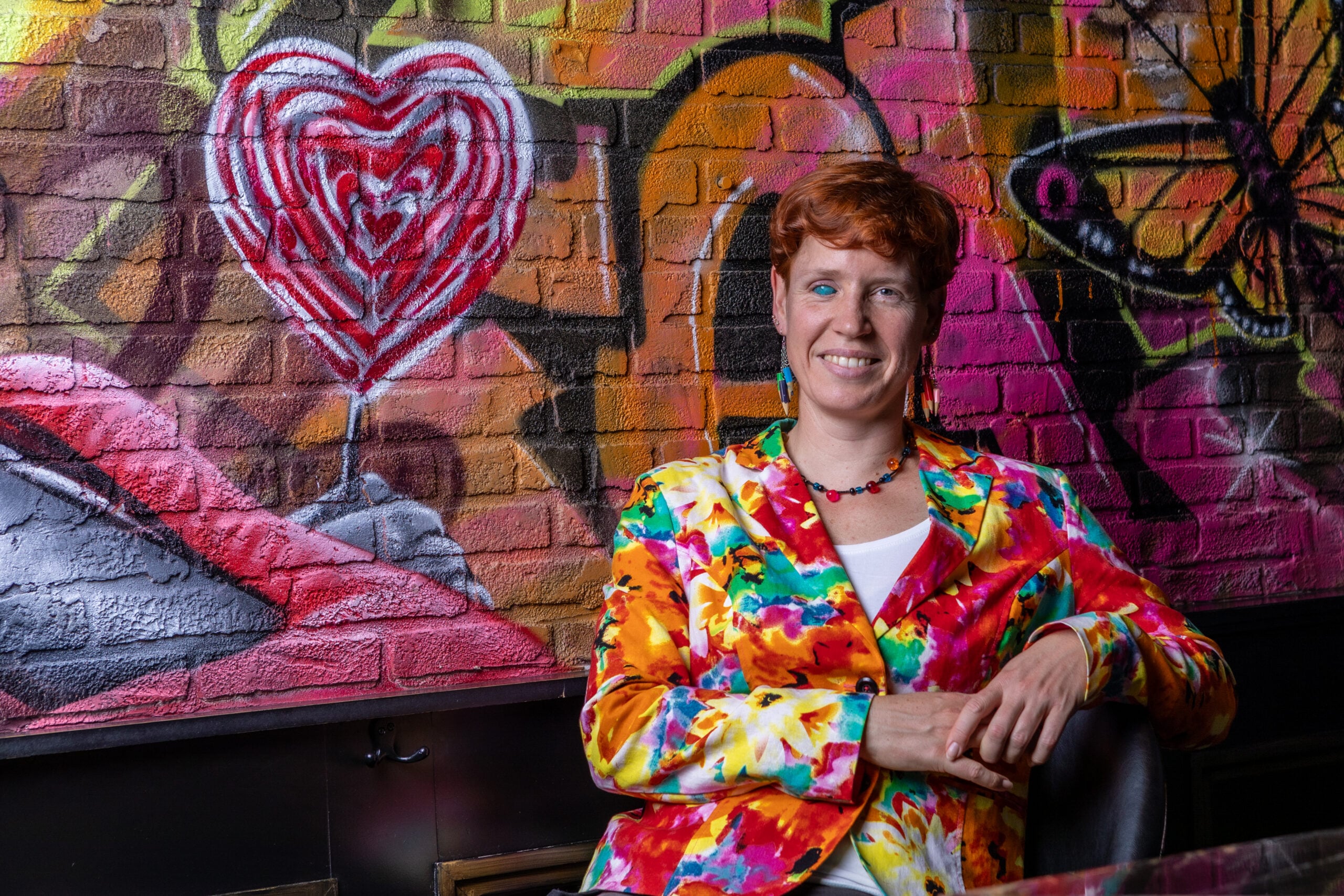

Brenda explains: “Actually, it had been noticed earlier. My mother had noticed that I was squinting, but the child health clinic said this was normal for young children. However, when a few weeks later my eye started tearing up and seemed to bulge outward, my mother decided to see the family doctor anyway. He referred us to the Ooglijdersgasthuis, where we were able to get an appointment the very next day.”
Because the cancer had already spread through the optic nerve into the brain, all the way to just before the optic chiasm, it was a very complicated surgery. It was a procedure that had never been performed before. That’s why extensive research had to be conducted first, and the surgeons even practiced on a donated body.”
A High-Stakes Operation
“Apparently, I was operated on by a very famous neurosurgeon; the whole hospital looked up to him,” Brenda says. This was followed by a surgery that lasted no less than twelve hours and a four-week stay in various hospitals in Utrecht. Not only was the eye removed, but other affected tissue also had to be excised. “My mother was told that the doctors would have to operate through my brain, with the risk that I might no longer recognize my parents. They even had to go through the emotional center. Sometimes I wonder if I’d be a different person if this hadn’t happened, but in the end, it doesn’t really matter. You can’t change it, and everyone goes through something in life that shapes them.”
Complications arose after the surgery. The puncture site from the spinal tap wouldn’t close, so Brenda wasn’t allowed to go to the children’s hospital; there was an outbreak of a contagious disease there at the time. “My mom even threatened to take me home. I was extremely stressed, had lost my day-and-night rhythm, and just had to get out of there. Only then did the doctors take action; they applied stitches, and I was allowed to go to an isolation room at the children’s hospital.” She was allowed to go home once her mother had learned how to care for the prosthetic eye. “Apparently, many parents found that scary, but my mother got the hang of it within a day and was allowed to take me home.”
Inspections
Brenda went to therapy as a toddler to work through the trauma. “I don’t remember any of it myself, but from what my mother has told me, I can imagine it was a profound experience. For my parents, too, for that matter.”
Until she was eight years old, Brenda underwent regular checkups to see if her other eye would also be affected. Her younger brother, who was three years her junior, also underwent checkups during the first three years of his life. Fortunately, everything else turned out to be fine: it was a random gene mutation and not a hereditary form.
“As far as I can remember, my childhood was quite normal. The bullying didn’t start until high school.” The harassment left me with a deep-seated insecurity. Even having my picture taken still makes me feel uncomfortable. “Even now that I can decide for myself how I look, it’s still a challenge for me to have my picture taken or to feel relaxed in new situations.”
Fun Prostheses
These days, Brenda no longer wears a realistic prosthesis in her free time. About ten years ago, she had a “fun prosthesis” made for an event: a turquoise stone. When she told a friend how nice it actually felt to wear such an unconventional prosthesis, he said, “Then why don’t you do that all the time?” Since then, she’s had a new novelty prosthesis made every two years. That way, her collection is steadily growing, and she matches her prosthesis to her outfit.
“I don’t want anything with an iris-like pattern in it anymore; then you can see all too clearly that the prosthesis isn’t moving with my eye. Besides, the great thing about a non-matching prosthesis is that people at least actually look you in the eye with your good eye. They make real eye contact, instead of you seeing them think, ‘Hmm… which eye should I look at?’ and then promptly choosing the wrong one.”
People are also more likely to ask what’s going on. “I prefer that to them making assumptions that aren’t true. Even though it can sometimes be tiring to tell the same story over and over again. Fortunately, I can also find the humor in it and joke about it.”
Training Actor
Brenda only wears a realistic prosthesis for her work. She is a trauma actor, primarily for the Ministry of Defense. This involves applying makeup to simulate injuries and acting as if she were the victim of a fight, explosion, or fire. The trainees must follow a medical protocol to stabilize her.
Brenda: “I have to pass as a soldier there. You can’t become one if you’re missing an eye, so it has to look like I have two fully functioning eyes. As part of their protocol, they have to check for a pupil response, among other things. Of course, my prosthesis doesn’t have one. That way, the instructor can clearly see whether a trainee is actually looking or just going through the motions.”
Meanwhile, there are quite a few stories about her making the rounds at the barracks. “I even have colleagues who are ‘accused’ of being ‘that actor with that eye.’ And yet they still often think they see a pupil reaction in my right eye.”
In addition to being a trauma actor, she also acts in training sessions on communication techniques and dealing with aggression. “For those training sessions, I discuss with the trainer beforehand what’s preferred: a fun prosthetic or a realistic one. That depends on the group and the topic of the training. I’ve also explicitly included it on my resume; it’s part of who I am.”
Happy with the knowledge I have now
Brenda is very happy to have the opportunity to wear fun prostheses. “I think this could have helped me as a teenager, but that option was never mentioned back then. I believe things are different now, and I’m very happy about that.” Her collection now includes several fun eyes, and she still has plenty of ideas.
Inspiring
“I also found it very inspiring to read Bram’s story in the March 2025 issue of the magazine about his ‘art’ eyes. It’s nice to see that I’m not the only one who chooses a fun prosthesis. In any case, I’m really glad I got to know this magazine; that was just last year, when I first visited ocularist Jelmer. I joined the association right away.”
