



Anouk Stein has been working as a consultant and communications specialist at Koninklijke Visio for over four years. An important part of her job is raising awareness among people who aren’t yet familiar with Visio. According to Anouk, this is desperately needed. “Many people simply don’t know we exist,” she says. “As a result, people often come to us too late, even though we can help them right after a procedure, such as an eye removal.” According to Anouk, many people think that support is only needed when vision is very poor. That turns out to be a misconception.
When people think of Visio, they often think mainly of assistive devices, but that image isn’t entirely accurate. “It’s not just about assistive devices,” Anouk emphasizes. “We’re not a store. The most important thing is learning to cope with a different way of seeing. That might mean learning to do things differently, using other senses, or learning to talk about how the loss of vision affects you. Acceptance is a key part of this. That’s often forgotten. Royal Visio helps empower people and helps them rediscover their potential.”
Koninklijke Visio has locations throughout the country. People can receive rehabilitation and counseling in Amsterdam, Apeldoorn, Breda, Eindhoven, Dordrecht, Goes, Heerhugowaard, Sittard, The Hague, Hoogeveen, Leeuwarden, Rotterdam, Vught, and Haren. Intensive rehabilitation is available at Loo Erf in Apeldoorn. “This is how we ensure that support is close at hand.”
Accessible
Laila Gaasbeek works as a low-vision specialist and orthoptist at Koninklijke Visio. In her work, she focuses primarily on visual functioning: what a person can still see, what challenges they face, and how those challenges can be addressed in daily life. According to Laila, support often starts with a low barrier to entry. “Not everyone needs to sign up right away,” she explains. “People can simply get information first, for example through Anouk. That alone can clarify a lot.”
When someone does sign up, the process begins with an intake assessment. Based on that, we determine what kind of support is appropriate. “We often start with a visual function assessment,” says Laila. “Then we look at exactly what the person can see and how we can compensate for any loss of vision—for example, with better lighting, magnification, or other adjustments to a computer screen.”
For people who see with only one eye, the support they need can vary greatly. “The field of vision becomes narrower, and binocular depth perception is lost,” Laila explains. “We make people aware of that. We give them tips and tools. This often takes place under the guidance of an occupational therapist and sometimes a social worker as well. An occupational therapist advises on practical adjustments in daily life. For example, using extra mirrors on a bicycle or in a car, or becoming more aware of your body. If you know where your body is, making precise movements becomes a lot easier. You can train all of these skills.”
Support can be provided either individually or in a group setting. “It depends on what someone wants and needs,” says Laila. In cases of anxiety or uncertainty—for example, regarding the other eye—a social worker or a behavioral scientist may also be involved. “At Visio, we definitely pay attention to the social-emotional aspects of living with a visual impairment.”
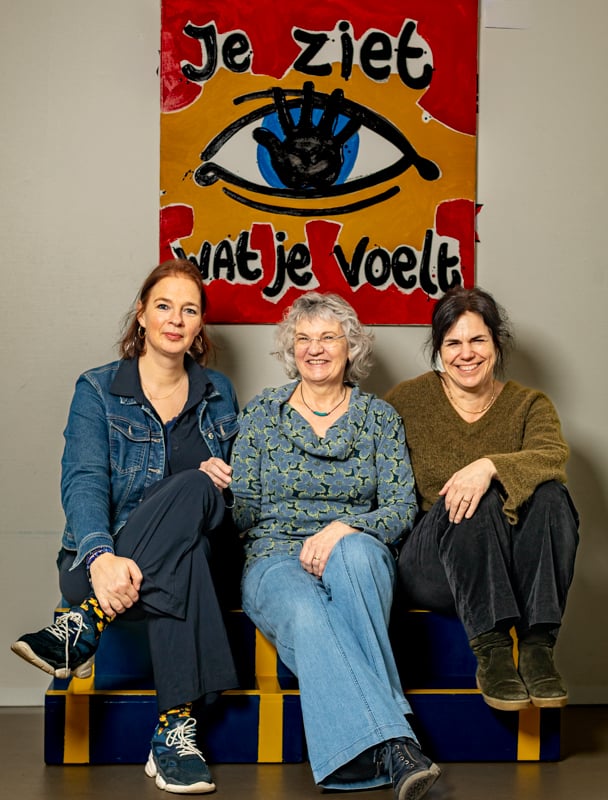
From left to right: Femke Braun, Laila Gaasbeek, Anouk Stein
Focus on the Request for Help
What Laila often hears from clients is that Visio really takes the time to help them. “People say, ‘It’s so nice that they take the time to calmly explain what’s going on and what you can do about it.’” She regularly hears about this contrast with the hospital. “An ophthalmologist often has very little time. We, on the other hand, help translate that information into everyday life.” The client’s specific needs are central to this process, Laila emphasizes. “Someone might come in with a question about reading, but if I see that glare is an issue, I’ll also discuss solutions for that. Sometimes you just have to look a little beyond the initial question someone comes in with.”
Visio is visible in many places, for example through low-vision consultation hours at hospitals, during meetings, and walk-in consultation hours at Visio locations. “People can walk in to these meetings without a referral,” Laila explains. “For tips, information, or an initial consultation.” Visio can also be reached by phone and email. “The help desk is staffed by people who know what they’re talking about,” she says. “Some staff members are visually impaired or blind themselves. That makes the interaction very valuable.” Visio also offers a wealth of practical information through the online Visio Knowledge Portal. There, you can find tips on useful apps, for example, as well as videos on a variety of topics, such as how to use a white cane.
If work plays a role
Femke Braun works as an Employment Advisor at Koninklijke Visio. Femke is part of Visio Zicht op Werk. “This department is made up of Employment Advisors who work throughout the country. We answer any questions people have about work. I support people, from the point of work absence through their return to work. This also includes helping them find suitable alternative employment. Suppose you suddenly lose vision in one eye due to a retinal infarction. In that case, you’ll often see an ophthalmologist first and then come to Visio. If it turns out that work is a factor, that’s when my colleagues and I step in. Together, we assess what someone needs to be able to continue working. This might involve practical instructions, workplace accommodations, or support in gradually building up their workload.”
“Our efforts often yield great results.” Femke cites real-life examples. “We supported a car mechanic who lost the use of one eye. He could no longer perform certain tasks, such as connecting wires. Through instruction and learning to see things differently, he was able to return to work.” A lab technician who had difficulty with precision work also received support. “After this training, she was able to resume her work.”
Femke’s work isn’t limited to people who are already in the workforce. Young people with visual impairments can also turn to her for help. “At the end of high school, we work with the student to assess their capacity, interests, and opportunities,” she explains. “We do this as a whole team, including a mental health psychologist, a low-vision specialist, an occupational therapist, an IT coach, and a social worker. This gives us a clear picture that helps with choosing a course of study and, later, a career.”
What Femke finds important is that people continue to believe in their own potential. “A visual impairment doesn’t automatically mean you can’t work anymore,” she emphasizes. “With the right guidance, accommodations, and time, people can often achieve much more than they initially think. At Visio, we all work under the motto: ‘What Is Possible.’”
More information
The Koninklijke Visio help desk is available on business days from 9:00 a.m. to 4:30 p.m. at
📞 088 – 585 56 66
✉️ kennisportaal@visio.org
Knowledge and Tips: kennisportaal.visio.org
Walk-in consultation hours and schedule: visio.org/overzichtspagina-agenda
All Visio locations: visio.org/locaties
Visible at Work: zichtbaarinwerk.nl
Reimbursement for healthcare: visio.org/wat-biedt-visio/zorgdeclaraties
