


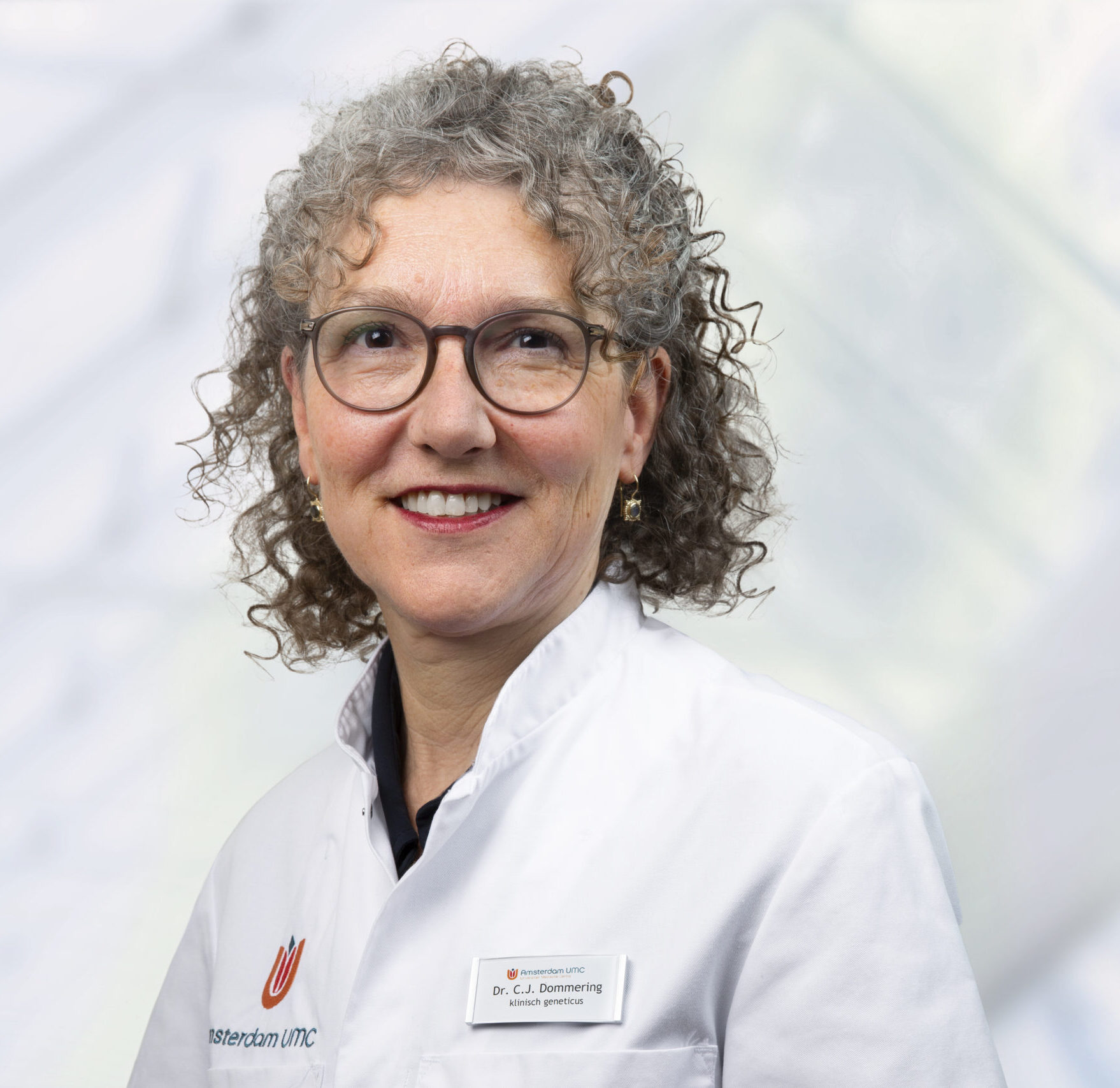

“At the Retinoblastoma Center at Amsterdam UMC, we help couples determine the best option for them to find out whether their baby has a genetic predisposition to retinoblastoma. We are the only center of expertise in the Netherlands for this condition. Of course, other hospitals can also help couples with their desire to have children, but they don’t know as much about retinoblastoma. You do need this knowledge if you want to help prospective parents—one of whom has had retinoblastoma—have a child.”
Dr. Dommering: “When a retinoblastoma patient is between the ages of 16 and 18, the ophthalmologists or pediatricians on the retinoblastoma team discuss the issue of heredity and explain that patients can always consult a clinical geneticist with questions about having children. Some come early on to find out what the process will entail, even if they don’t have a partner yet. Others come with their partner when they’re actually ready to start a family. I then explain the various options to them in detail.”
What is retinoblastoma?
Retinoblastoma is a rare form of retinal cancer that develops as the eye grows. It occurs primarily in children under the age of 4. Retinoblastoma can affect one eye (unilateral) or both eyes (bilateral). In most cases (85%) of unilateral retinoblastoma, the condition is not hereditary. If a child has retinoblastoma in both eyes, the disease is always hereditary. In the Netherlands, the disease is diagnosed in an average of 10–12 children per year. Approximately 60% of these children have unilateral retinoblastoma, and 40% have the bilateral form. Most children treated at Amsterdam UMC are the first in their family to have this condition.
What treatment options are available for people with hereditary retinoblastoma?
Option 1
: People choose not to have biological children, opt for foster or adopted children, or become pregnant using a donor egg or sperm.
Option 2
Couples may also choose to conceive naturally and not to undergo testing before or during pregnancy, but only after the baby is born. Labor is then induced at 38 weeks so that any necessary treatment can begin in a timely manner. Umbilical cord blood is collected immediately after birth to test whether the child has a genetic predisposition to retinoblastoma. Results are usually available within two weeks. As soon as the mother and child are able to travel to Amsterdam UMC (usually within a week), they will see an ophthalmologist for their first examination. If the blood test shows that there is no genetic predisposition, no further checkups are necessary.
Option 3
You can also choose to conceive naturally and terminate the pregnancy if it turns out that the fetus has a genetic predisposition to retinoblastoma. During the pregnancy, a chorionic villus sampling (CVS) test is performed around 12 weeks or an amniocentesis around 14 weeks. There is, however, a risk of miscarriage as a result of the procedure: approximately 1 in 200 women experience a miscarriage due to the chorionic villus sampling, and 1 in 500 as a result of the amniocentesis.
Option 4
Couples can also opt for Preimplantation Genetic Testing (PGT). This is the medical term for embryo selection. First, genetic testing is performed. A unique genetic test must be developed for each couple. Developing the test can take one to two years, depending on the situation. In vitro fertilization can then take place. Health insurance covers three attempts. The number of suitable embryos per attempt and the outcome of the embryo transfer can vary. The average chance of a couple becoming pregnant after these three attempts is 40 to 50 percent. Would you like to read more about PGT? Visit www.pgtnederland.nl
Parents who have had a child with retinoblastoma but do not themselves have the genetic predisposition cannot undergo PGT. If these parents have another baby, umbilical cord blood is always collected after birth to rule out the possibility that this child also has a genetic predisposition to retinoblastoma. This occurs only very rarely in this situation.
Want to know more?
Would you like to learn more about genetic testing for retinoblastoma? If so, please ask for a referral to the Clinical Genetics Outpatient Clinic at Amsterdam UMC. Amsterdam UMC is home to the only center of expertise for retinoblastoma in the Netherlands. For more information, visit: www.retinoblastoom.nl
