



Not in a glass jar
The radiation treatment has made the blood vessels in Zoë’s right eye very porous, increasing the risk of bleeding. The hospital therefore advised her, for example, never to take up boxing. Her mother, Yvonne, explains: “When Zoë showed an interest in field hockey, I dismissed it until she came up with her next enthusiastic idea—korfball. But on the other hand, I didn’t want to put her in a glass case either. That wouldn’t have made Zoë happy.”
Last korfball season, Zoë lost her balance once while jumping and landed on her head. That was a scary moment. For a split second, she couldn’t see a thing. Zoë: “But I could also bump my head against a table. So it’s not possible to protect it completely. Glasses aren’t an option because the tumor remnants are located right in the center of my eye. That would cause me to look right into the frames, which would actually obstruct my vision even more.”
Athletic and Caring
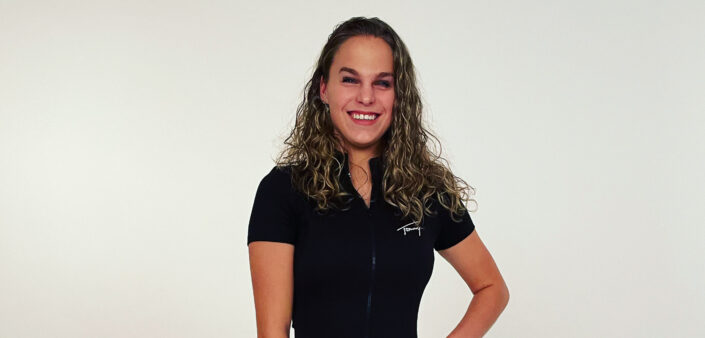
Zoë describes herself as determined, cheerful, caring, athletic, and a perfectionist. These wonderful qualities also come to the fore when she talks about being a buddy to a family whose son has retinoblastoma . The family can turn to Zoë with all kinds of questions—for example, about how she managed to succeed in mainstream education and what accommodations helped her. “Among other things, I had a table that could be tilted, books in A3 format, colored paper with bold print, and an electric magnifier. I really appreciated being able to talk to someone at Visio who had the same problem as me. It’s very important to be able to share your experiences with someone in the same situation.”
Which bus is right for me?
When we ask if there are any challenges she faces, Zoë mentions public transportation to school: “The buses arrive at almost the same time and have the same numbers. I can’t tell where the bus is going. So it’s hard to figure out which bus I need to take.” Zoë’s mother came up with a system where you can scan a QR code on the side of the bus. As soon as you scan the code, your phone tells you where the bus is going. Unfortunately, this great idea has remained just that—an idea. Until then, Zoë is either driven to school or bikes there (about 30 to 35 minutes).
That immediately brings back a funny memory for Zoë. She talks about the times she had to bike to korfball practice in the dark, with no streetlights. She couldn’t see the road in the dark, so she just followed the red taillight of her sister, who was biking ahead of her. “And here I was thinking they were cycling safely,” her mother remarks offhandedly.
Fatigue
The conversation then turns to the things that bother Zoë in her daily life. She mentions her fatigue. Especially when she’s had to concentrate a lot, she notices that her vision becomes blurry and she’d rather just stay in bed. When asked if she takes that into account, she says, “Not really. I don’t let much hold me back. I’m always looking for a solution, like with biking. I’m so grateful for the people around me. They’ve helped me whenever I needed it. It was also so nice that I could follow my twin sister’s example. That’s how I was able to ride a bike, play korfball, and do so much more—things I would otherwise have had to figure out all on my own. I don’t think I would have ever become so good at korfball without my sister.”
Quick Test
Zoë has always really wanted to know what it’s like to be able to see fully. Her mother picks up on this: “People often say, ‘You don’t see as well.’ But for Zoë, that’s her normal vision. To find out what Zoë actually sees, I once sat with her on the curb. We both had to keep looking straight ahead toward our house. Her sister would then walk by. If we saw her—without turning our heads—we had to say ‘yes.’ And also when we couldn’t see her anymore. We drew a line on the street with sidewalk chalk. That way, we could literally see how much each of us could see. But in the end, I also told Zoë that it wasn’t something she needed to worry about. After all, if you turn your head, you can see it too.”
Keep going
When I ask Zoë if she can also look at the situation so objectively, she agrees:“You can’t change the situation anyway. Of course, I get sad sometimes, too. It’s okay to feel those emotions. But it’s also important to just keep going and focus on what is possible. Don’t let anything hold you back! If I’d let my limited vision stop me, I’d never have become the Dutch Indoor Korfball Champion at Ahoy.”
