



The consequences were horrific. After he was rushed to the hospital, it turned out that his eye had been shattered. “Surgery was needed immediately. I was transferred from the hospital in Veldhoven to the Eye Hospital in Rotterdam. They told me right away that there was only about a 2 percent chance I’d ever see out of that eye again. But it couldn’t be saved. I then underwent an eye removal surgery.” When I woke up after the surgery, I couldn’t see a thing. Both eyes are connected by muscles. The muscles in my good eye were so cramped that I couldn’t see anything with my left eye either. Fortunately, my vision did return after a few days.” The friend whom Youri had hit with the stick came to visit him in the hospital. “He felt incredibly guilty,” Youri recalls. “But I wasn’t angry with him. He didn’t do it on purpose.”
Top Handball Player
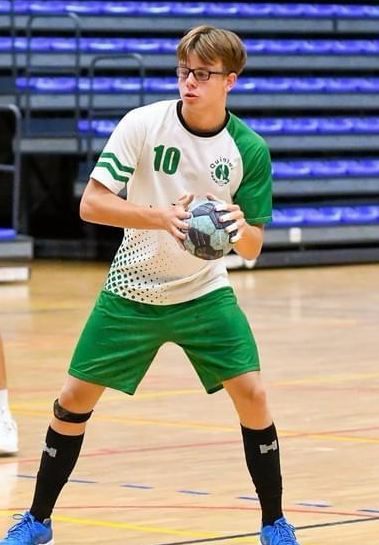
His recovery went well, but it was still difficult for Youri. Suddenly, he had a tremendous amount of trouble perceiving depth. He’d spill drinks right next to his glass. Or he’d start writing before his pen had even reached the paper. And he also feared for his greatest passion: handball. After all, how could he ever become a top handball player if he could only see out of one eye? “When I was slowly allowed to start playing handball again, I had a really hard time with it,” he recalls clearly. Not being able to see depth made it difficult to judge distances correctly. Youri could barely catch the ball anymore, and part of his field of vision was gone. “It took a long time to get used to. My mom also made me wear glasses for safety. I was afraid that a finger might get into my good eye while playing handball. At first, I didn’t want to wear those glasses. They just made seeing even harder.” It was then that the young athlete considered quitting handball. “I thought: I’m not going to play sports with such ugly glasses. I’d rather quit. In the end, I started wearing them anyway. My mom was right, of course, and I continued playing handball. I’d still rather not wear those glasses, but then I’d get into an argument with my mom…” Fortunately—first and foremost for himself, but also for handball fans—he followed the advice of his loved ones. “My parents have always given me the support I needed. My teammates all accepted that I wore glasses during games and practices. I was never laughed at or made fun of because of it. It was accepted, especially because the story behind it was clear.”
Blind spot
The left-handed player is now in his third season with Quintus, which competes in the men’s premier league. He has also been playing for the Dutch national team for a year. “Because I was still young when the accident happened, my brain was able to adapt to the new situation. If something like that happens at an older age, it’s probably much harder. When playing handball, I especially have to keep in mind that I have a significant blind spot on the right. Of course, the game moves so fast that I sometimes don’t see an attacker on the right. That’s frustrating for me, but also for the team.” Fortunately, though, Youri has plenty of skills to make up for it. He’s very fast and has good passing moves.
Jokes
During the day, Youri Schutte is studying to become a junior account manager at Da Vinci College in Dordrecht. But what he loves most is training and spending a lot of time playing handball. Other than that, having an eye prosthesis doesn’t play a major role in his life. People he doesn’t know don’t bring it up with him either. “Most people, once I tell them after a while, say they thought I had something like a lazy eye. You always think people can see it. That makes me feel insecure sometimes. But by now I also know that a lot of people don’t even think about it at all. My friends sometimes joke about it, too—something along the lines of, ‘I bet you didn’t see that again.’ But I can laugh it off. It doesn’t bother me.”
Driver’s License Exam
Youri has also passed his driver’s license test in the meantime. “I had to take the driving test three times. But I can’t say for sure if that was because of my prosthesis,” he says with a laugh. “I did have to demonstrate beforehand that I could look far back over my shoulder—to make sure I could take in the entire traffic situation. I explained this to the examiners before every test, because otherwise they might have wondered, ‘Why is that guy looking back so much?’ Not looking enough isn’t good. But apparently, looking over your shoulder too much isn’t ideal either.”
Special thanks to Peter Lotman, who previously published an interview with Youri Schutte on www.handbalstartpunt.nl and in the Algemeen Dagblad.
