


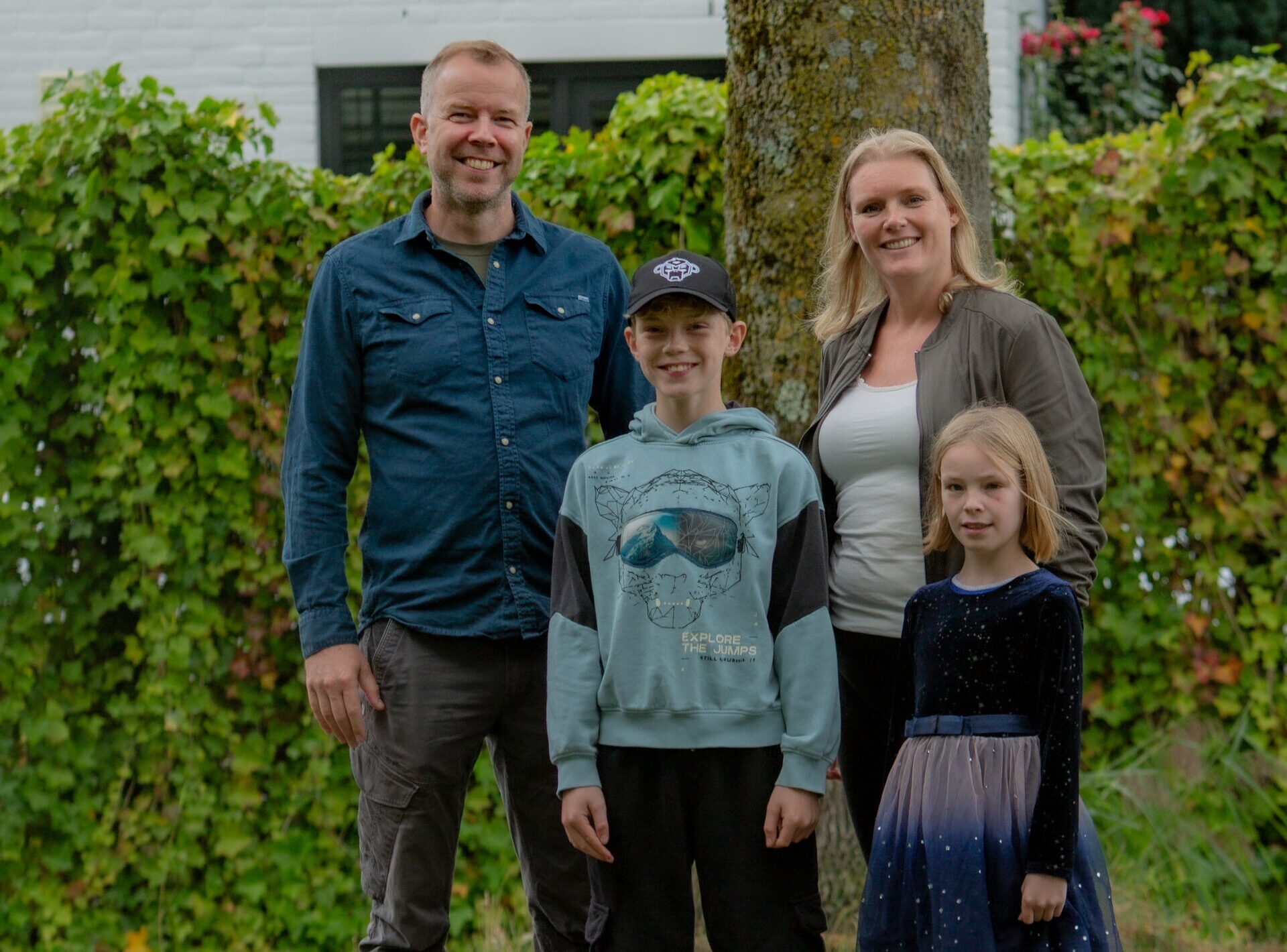

“We know from research that siblings of children with a serious illness or disability take on a lot of responsibilities,” says researcher and educational psychologist Linda Veerman of VU University Amsterdam. “They’re also less likely to ask for help and often keep emotions like anger, sadness, guilt, and shame to themselves. Furthermore, attention usually focuses on the child who requires care. That’s why siblings are sometimes called ‘glass children’—because adults, as it were, look right through them to their sick brother or sister. It’s important to recognize and support siblings from an early age. This not only contributes to their well-being but also reduces the risk of psychosocial problems later in life. To help achieve this, we decided to develop a serious game for siblings aged 6 to 9 through the Affect-us academic workshop (www.affect-us.nl). This became the sibling game ‘Broedels.’”

Linda Veerman
The game
Linda continues: “Research showed that the game can help siblings cope with having a brother or sister with a medical condition or disability. Most children and parents found the game fun, useful, and educational.”
Parents and children said the game had helped with a number of things, namely:
- Knowing that you’re not the only one.
- Recognizing and acknowledging emotions and needs, and expressing them.
- Dealing with emotions and situations.
- Strengthening open communication and family relationships.
Since early 2025, the game has been available for free to everyone in the Netherlands and Flanders via www.brussengame.nl. Families can use the game, along with the accompanying worksheets and parent guide, on their own. Broedels can also be used by professionals. Various materials have been developed to accompany the game for this purpose, which can be found on the same website. Linda: “A new project was also recently launched, in which researcher Annemieke de Kat-Hooydonk will develop a game for teenage siblings. Families and professionals interested in participating in this research can contact us at info@brussengame.nl.”
Parental Burnout
Agnes Willemen is a special education specialist, as well as a lecturer and researcher in the Department of Pedagogical and Educational Sciences at Vrije Universiteit Amsterdam. She conducts research on stress and exhaustion among parents of children with long-term care needs. Some parents use the terms “burnout” or “burn-on” to describe how overwhelmed they are. To gain a better understanding of what parents mean by the term “burnout,” Agnes and her colleagues have conducted research in recent years on burnout among parents of children with special needs.
Agnes explains: “More and more researchers are studying burnout among parents. We found 57 studies on burnout among parents of children who require special care. These studies show that parents of children with special needs experience burnout symptoms more frequently and to a greater degree than parents of children without special needs. The literature indicates that 20 to 77 percent of these parents experience burnout. Among parents without a child with special needs, this figure is lower: 20 to 34 percent. It also appears that mothers are more likely to experience burnout than fathers.

Agnes Willemen
“There is no single cause of burnout. It can be different for every parent. Often, it involves multiple issues occurring at the same time. What helps prevent or reduce burnout also varies from parent to parent. Every parent needs something different. That’s why a personalized approach is so important.”
Three themes
There is still no clear, established definition of burnout among parents of children who require special care in the scientific literature. For this reason, the researchers asked 38 parents to explain what burnout means to them. Some of them had experienced burnout themselves.
From their stories emerged three clear themes :
1. It takes a long time and sometimes comes back
Many parents said that burnout doesn’t just go away. Recovery can take years. Some parents even doubt whether they’ll ever fully recover. They say there are good days and bad days. That’s why it’s better to talk about burnout-related symptoms that sometimes are more severe and other times are less noticeable.
2. From stress to overload and ultimately exhaustion
Parents describe burnout as a process that gradually gets worse.
- It starts with stress-related symptoms.
- Next comes overexertion.
- Ultimately, this leads to exhaustion.
They mention physical symptoms, fatigue, poor sleep, trouble concentrating, anxiety, tension, and feelings of sadness. Not everyone experiences the same symptoms, and they vary in intensity. Parents explain that they move back and forth between these phases.
3. Being in survival mode
Many parents recognize burnout as a kind of survival mode. They try to keep going and pretend everything is fine (fighting), but at the same time withdraw from others and sometimes even from themselves (fleeing). Often, parents don’t realize until later that they were in this survival mode. Researcher Agnes sums it up this way: “Parents often rely on willpower for too long. It’s only in hindsight that they realize how exhausted they actually were.”
Burn-on
The three themes parents mention align well with the term “burn-on,” a term some parents use themselves. “Burn-on” is similar to “burnout,” but there’s one major difference: someone experiencing “burn-on” keeps going. To the outside world, it seems as if everything is going well. But on the inside, that person feels empty, distances themselves from themselves and others, and sometimes feels that everything is meaningless.
Agnes says, “For parents of children who need extra care, ‘burn-on’ is particularly relatable. They are always responsible for their child. You can’t just let go of that responsibility or pass it on to someone else. That makes their situation different from a work-related burnout. Still, the research also shows that small things can help. Parents themselves—but especially the people around them—can take steps to make the situation a little easier.”
Burn-on tool
“From our conversations with parents, we’ve learned what they believe causes burnout and what actually helps,” the researcher explains. “We’ve compiled these risks, protective factors, and tips into the ‘Burn-On’ tool. The tool is available on the (Sch)ouders website and is intended for parents, their loved ones, and healthcare professionals.”
More information:
The burn-on tool
www.schouders.nl/burn-on
A Guide for Parents of Children with Special Needs
schouders.nl
Kind & Zorg Foundation
This organization advocates for optimal medical care for children
www.kindenzorg.nl
Support for young caregivers (such as siblings)
www.regelhulp.nl/onderwerpen/broers-en-zussen
