


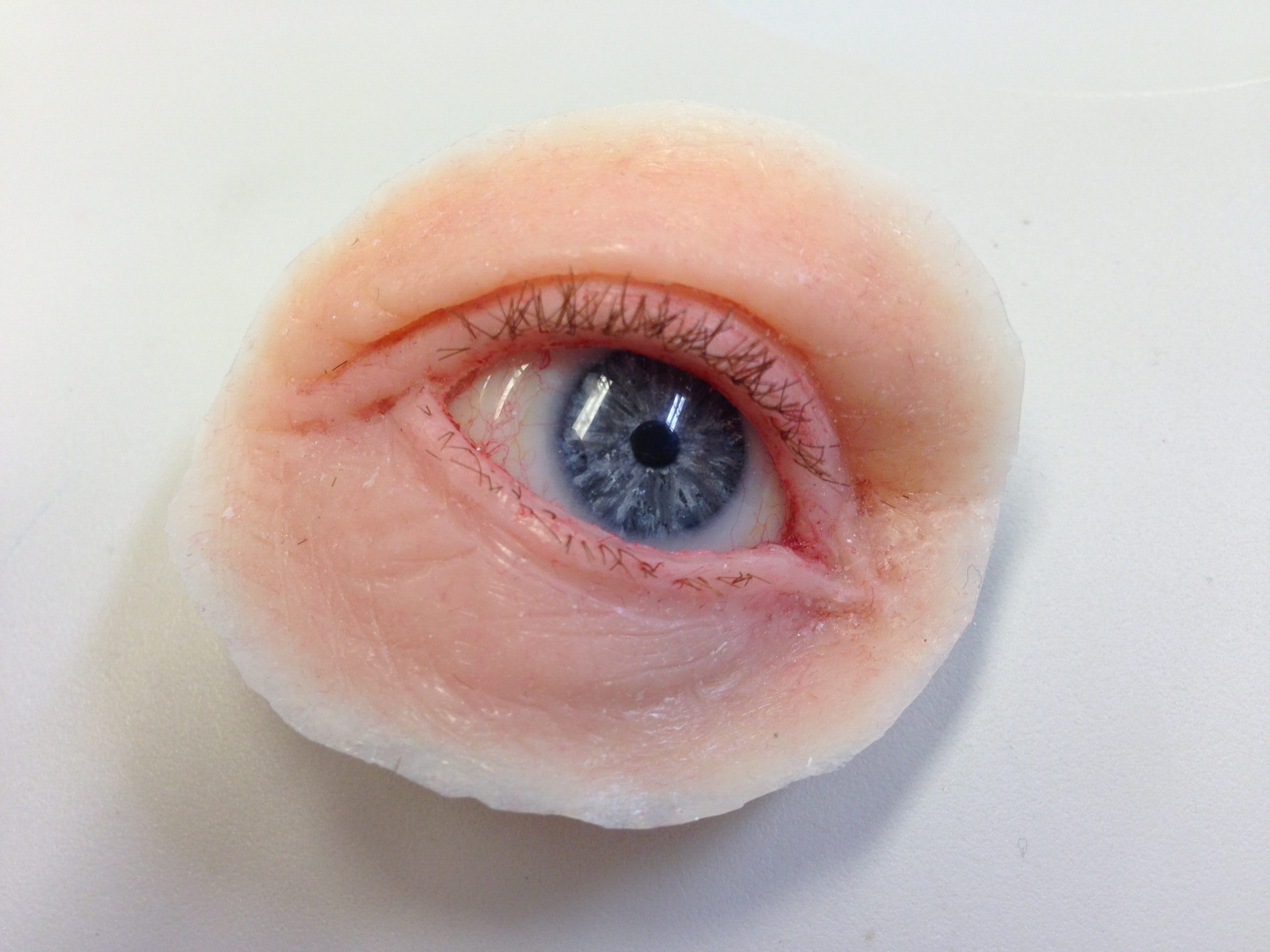

In almost every hospital, the makers of facial prostheses have different job titles. For example, they are called anaplastologists,maxillofacial prosthetists, or facial prosthetists. But ultimately, they all do the same work. They make ears, eyes, and noses out of silicone for people who are missing them. The reasons why people need a facial prosthesis vary. Sometimes a part of the face is missing at birth. There are also people whose faces have been damaged in an accident or who have had a portion of their face removed due to cancer.
Facial prostheses are made at nearly all academic medical centers: UMCG (Groningen), UMC Utrecht, Erasmus MC (Rotterdam), AZM (Maastricht), Radboudumc (Nijmegen), and LUMC (Leiden). The AVL manufactures the prostheses. for their own patients and for Amsterdam UMC. Every year, the prosthodontists from the various centers meet to consult with one another.
Orbital prosthesis with an artificial eye
People who receive an orbital prosthesis with an artificial eye have often been in an accident or are dealing with cancer. It is extremely rare for a child to need a prosthesis with an artificial eye due to a congenital condition. Pascal explains: “When people need surgery due to an accident or cancer treatment, we in Nijmegen usually place facial implants during the same procedure. The implants are screwed into the bone. Later, the orbital prosthesis can be attached to the implants using magnets. We use this method frequently at Radboudumc, but the approach chosen varies by center.” Shirley adds: “At the AVL, you often see the prosthesis attached to the skin with adhesive. That’s because sometimes cancer patients have undergone so many surgeries or radiation treatments that implants simply aren’t an option anymore.”
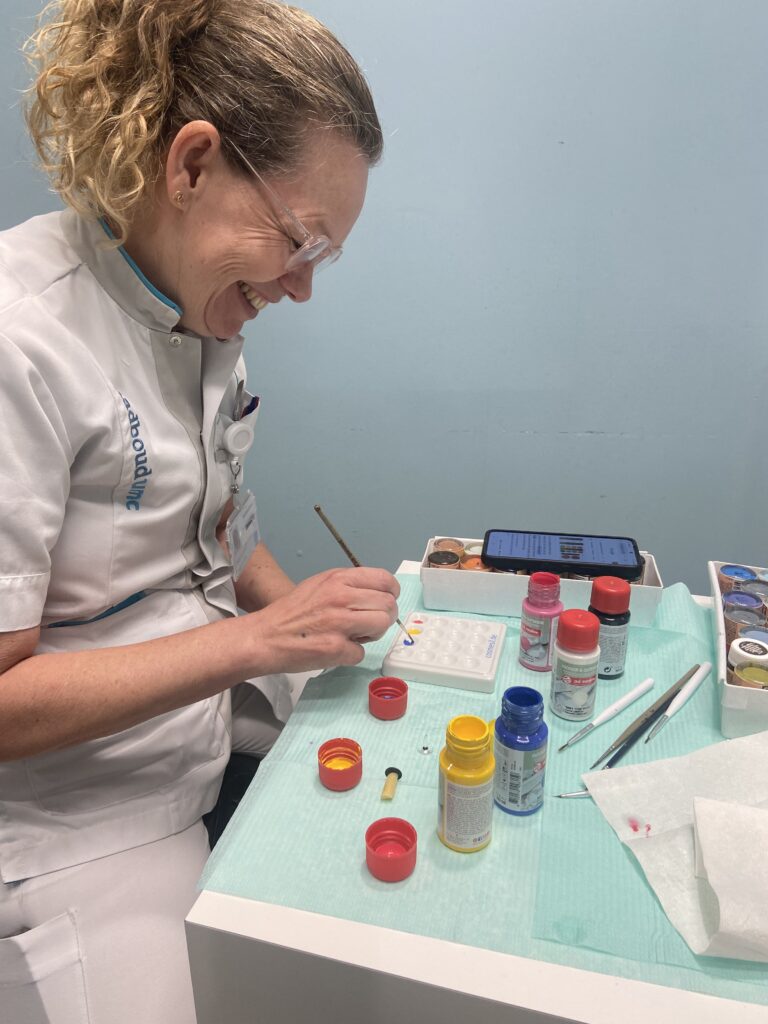
Pascal van de Pol
Implants and Sleep
Before the surgery, the prosthodontist is involved in the implant planning process. Together with the head and neck surgeon and the 3D lab, they determine the best location for the implants. Once patients have received their implants during surgery, a prosthesis cannot be made immediately. Pascal: “We say that the implants are still ‘dormant.’ It takes three months for them to fuse properly with the bone. And if patients still need radiation therapy, the surgeon will check after six months to see if there’s sufficient blood flow to expose the implants so the so-called abutments can be placed.” Abutments are small tubes that are screwed into the implants and protrude through the skin. The magnets will later click onto these.”
So it can sometimes take up to a year before people can actually start wearing the prosthesis. In the meantime, the wound care nurse plays an important role. She has special bandages that protect the wound and ensure that people don’t have to walk around with an open wound. These are special bandages that also don’t put too much strain on the skin.”
The following steps are followed when creating a facial prosthesis (epithesis)
- Choosing Between Adhesive and Implants
There are two ways to secure the prosthesis: with adhesive oron implants. If possible, the surgeon places the implants during surgery. Implants provide a secure anchor for the prosthesis. Once the skin has healed after surgery and/or radiation therapy and the abutments have been placed, the fabrication of the prosthesis can begin.
- Facial Impression
First, an impression is taken ofthe specific part of the facewhere the prosthesis will be placed. This is done using a rubber-like material. The purpose of this impression is to create an accurate model of the face. - Making an artificial eye
In some hospitals, the prosthetists make the eye shells themselves. In other places, they are made by an ocularist. - Wax Epithesis
Based on the impression and, for example, a photograph, the prosthetist creates a waxepithesis. This model is precisely adapted to the shape and structure of the affected area. During the second appointment, the patient tries on this wax epithesis. Together with the prosthetist, they determine whether any further adjustments are needed. - Making a Molding
If the wax model is good, a molding can be made from it. This is filled with silicone that has been colored to match. - Fitting the prosthesis
The facial prosthesis will be fitted at your next appointment.
Care of the Orbit prosthesis
The patient can use the facial prosthesis for about a year and a half, provided it is properly maintained. Shirley: “The silicone prosthesis wears down due to the skin’s acidity and discolors from sunlight and smoking. An adhesive prosthesis wears out faster than one with implants. This is because of the need to clean the adhesive edges. Keeping the prosthesis clean affects its lifespan. You can never completely prevent bacteria from accumulating on the prosthesis; ultimately, there will always be an open connection to the implants or the wound. That’s why it’s very important to rinse the face and the prosthesis thoroughly, for example, with a showerhead. People who are less careful about this are more likely to develop infections. We also recommend Hibiscrub. This scrub has antibacterial properties.”
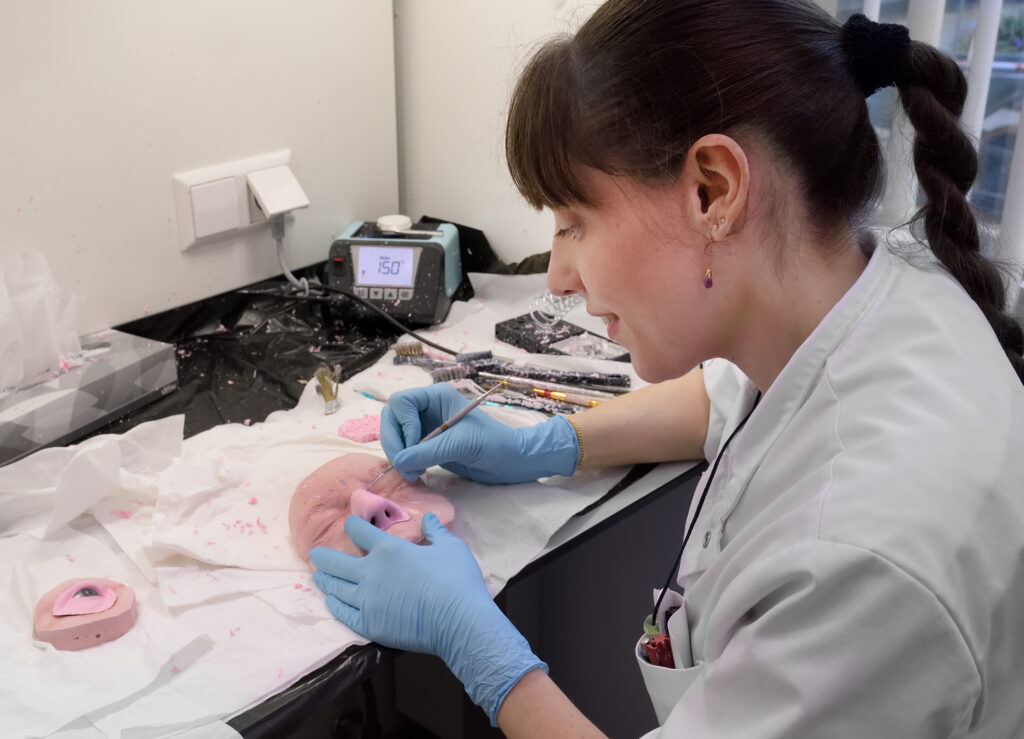
Shirley Bouman
No training for
Shirley and Pascal agree that their work is very rewarding. The interaction with patients is valuable, and it’s also a creative profession. However, there is no training program in the Netherlands for making facial prostheses. Shirley completed her training in Toronto. “It wasn’t a specialized program, but I mastered as many techniques as possible.” Pascal learned the trade through dental technology. “I learned how to make epitheses from another prosthodontist.”
Is the 3D printer the future?
Just like ocularists, prosthetists are also discovering the possibilities of 3D printing. Shirley: “At the AVL, we’ve been conducting research for six years, sometimes with as many as four or five studies underway at the same time. But we still do a lot of work by hand. The results from the printer just aren’t good enough yet. By doing things by hand, we can still deliver the best final product. Making orbital prostheses involves many steps and fitting phases. You’re dealing with many different components. You keep making small adjustments along the way. When working by hand, it’s easy to make adjustments as you go.”
Want to know more?
A regular feature of the exhibition at the Utrecht University Museum is facial prostheses, including orbital prostheses. They show how these were made around 1900, as well as how they are made today. In a short video at the exhibition, Maartje Kienhuis of Utrecht UMC explains how she makes an orbital prosthesis.
umu.nl
The Eigen Gezicht Foundation helps people with facial abnormalities become more socially resilient and capable. Check out their informational materials
