



In the waiting room, Cor explains that he started having problems with his right eye 12 years ago. It soon becomes clear that he is dealing with the Acanthamoeba parasite, which is found in tap water. The parasite had lodged behind his contact lens, causing an infection in his cornea. After years of problems with his eye, he decides—partly on the advice of a family member who has an artificial eye himself—to have the affected eye removed. A big step. But the surgery last March was a success. And today he’s taking the next step: getting a nice new artificial eye. Cor explains: “I now have a glass one from the Eye Hospital in Rotterdam. These are typically fitted after the eye removal surgery is complete, but while you’re still under anesthesia. That was really nice, because it meant I could walk down the street pretty soon after the surgery without it really standing out. However, this prosthetic eye is a bit too small, and the color is too dark. I hope Frédérique can make a larger one so that my eyes look a little more alike again.”
Daytime Eye Prosthesis
Once in the exam room, Frédérique examines the eye socket that underwent surgery. “It looks really good,” the ocularist agrees. Calmly and with a touch of humor, Frédérique answers Cor’s questions. For example, he wants to know if she can use his new ocular prosthesis to prevent his eye from drooping slightly when he gets tired. She replies firmly, “I make an eye prosthesis for daytime use, not one for after six.” She then calmly explains that she can’t completely prevent the eye from drooping slightly when it’s tired.
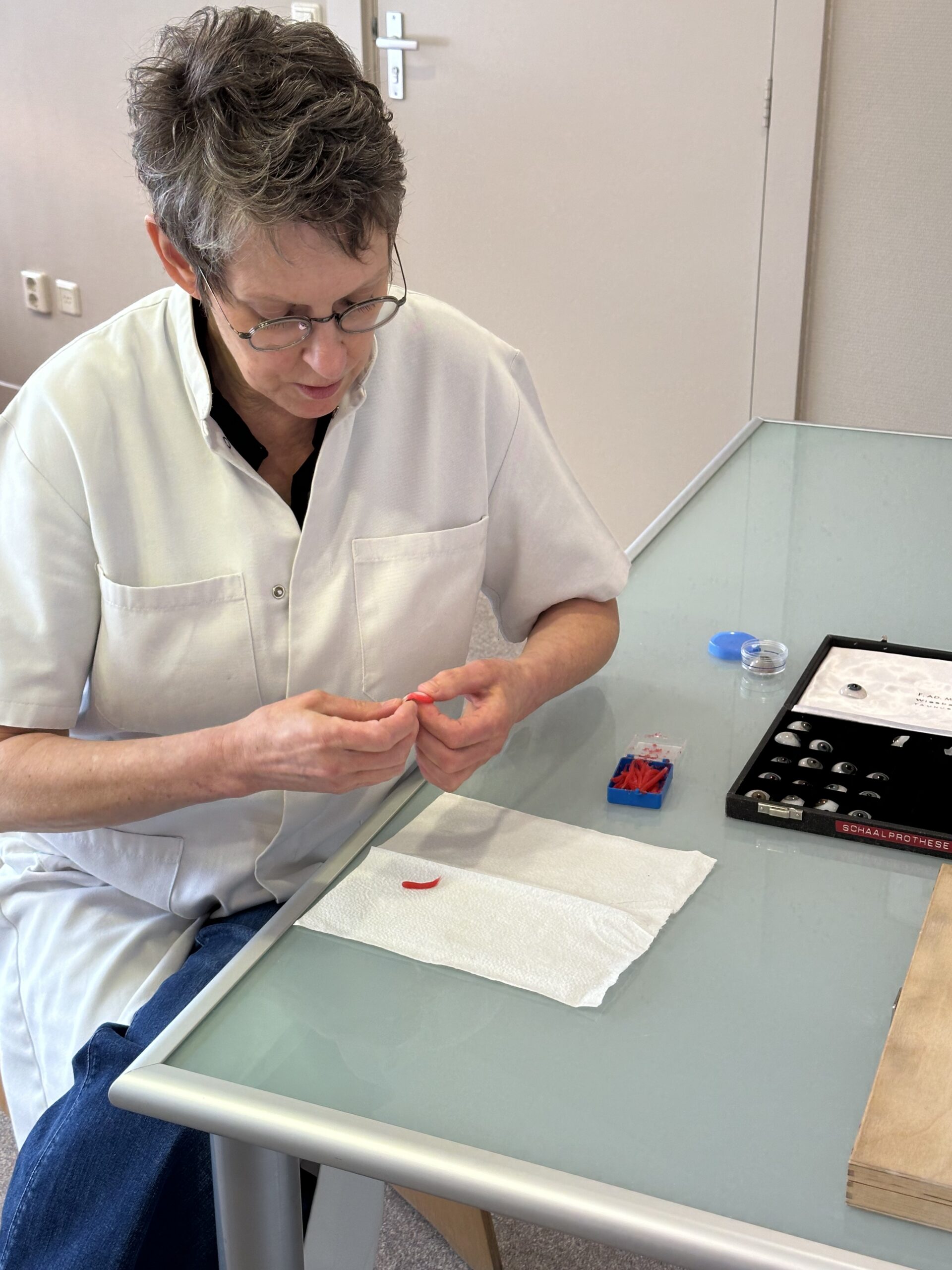
Frédérique then gets to work with intense concentration. After trying on the base model, she sculpts the final design she wants using red wax. Doesn’t she need to take measurements and try it on first? “You’re looking at 30 years of experience here,” she says with a laugh. “By looking closely at his face and eye socket, I can create a model with wax. The next step is determining the color and pattern of the eye.” Frédérique walks over with a large container of blue prosthetic eyes. She carefully examines various examples and compares them to Cor’s good eye. One is too light and another too dark. And there needs to be a rim around the iris. In the end, she’s selected three color samples. “It will be a combination of these three,” she explains, describing the selection process. Cor wonders if she might take another photo of his good eye. That’s not necessary; in fact, it would be counterproductive: “The eye reacts to light, so the color of the eyes changes in the photo. Experience has shown that this manual method provides the best color representation,” she explains. Cor’s first consultation is over. In three weeks, he can pick up his ocular prosthesis. “Then we’ll fit the prosthesis, I’ll grind it to size, and put the finishing touches on it,” Frédérique concludes.
Secret Recipe
After saying goodbye to Cor and his wife, Frédérique shows us the laboratory where the prosthetic eyes are made. Carmen, a technical assistant, is working on the plaster molds used to create the prosthetic eyes. The prosthetic eye is then passed on to Rik. He paints the iris and uses thin silk threads to create the blood vessels on the artificial eye. After that, it is polished, and the artificial eye is ready. Frédérique: “A striking feature of a Frédérique Bak artificial eye is that the iris has a lot of depth. That’s kind of my secret recipe.”
Frédérique doesn’t just work in The Hague. She also holds office hours in Zaandam, Utrecht, Leeuwarden, Hattem, and Breda. “That’s one of our core principles: that we operate nationwide. And the fact that I work closely with the orbital specialist and nurse practitioner at UMC Utrecht allows us to provide that extra bit of care. I have the same great collaboration with the specialists at the Ophthalmic Medical Center in Zaandam. We consult with each other frequently.” In addition, during her consultation hours, Frédérique always pays close attention to the psychosocial aspects of an ocular prosthesis. “I’m a people person. That’s why I think it’s important for people to be able to share their stories. After all, losing an eye is a traumatic experience, and that deserves attention.”
Messing Around with Plaster
Making artificial eyes is a highly skilled craft. Where do you actually learn that, since there’s no formal training for it? Frédérique: “I stumbled into it by chance. When I was in my early twenties, I started working as a temp for ocularist Erica Groet. I was hired to make coffee, but when I saw what they were doing there, I told her, ‘I can mess around with plaster a little, too.’ From that moment on, Erica began training me. I worked for her for twelve years. And I’ve now had my own practice for about 24 years.” Meanwhile, her daughter Floortje (who paints and handles business operations) and son Pepijn (who applies plaster, grinds, and polishes) also work a few days a week at their mother’s practice. Hostess Jamila welcomes visitors and handles inquiries via email and phone. In addition, Jan Bollemeijer is training with Frédérique to master the craft of ocularistry. “I’ll keep going for a while, but when I eventually stop working, the business will continue.”
Watch this short clip from the show “Klokhuis” to see how Frédérique’s artificial eye production process works.
On Frédérique’s website, she answers frequently asked questions about eye prostheses.
