



Drivers often fail to maintain a safe following distance from one another and—even worse—they drive right on top of the car in front of them. This results in many collisions. In my training sessions for claims adjusters handling traffic accidents, we discuss who is liable in such a situation. Is it the car in the rear for failing to maintain a safe following distance? Or is it the car in front because it braked suddenly? For those who are curious about the answer, I’d be happy to explain who is liable in this case
Imagine you’re driving 100 km per hour
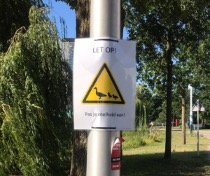
Suppose you’re driving on the highway at a speed of 100 km per hour. Suddenly, a mother duck and her ducklings cross the road. What do you do? Hit the brakes or keep going? For your own safety and that of others, it’s best to keep going. But it’s more likely that you’ll reflexively hit the brakes. There’s a good chance the driver behind you will brake just a little later and rear-end your car. Who is liable in that case?
Who is liable?
One of the fundamental principles of traffic law is: “A driver must be able to bring the vehicle to a stop within the distance over which he can see the road and over which the road is clear.” In simple terms, this means: you must maintain a sufficient distance to be able to brake if necessary. Therefore, you must not drive too close to the vehicle in front of you. If you collide with the car in front of you, there is a presumption that you did not maintain a sufficient distance. In principle, you are then liable for the resulting damage. In principle, because you may try to prove that you did maintain a safe following distance and that the collision was caused by something or someone else. For example, that you were forced forward by a car tailgating you or because the car in front of you braked “out of the blue,” without any necessary reason. Another fundamental principle of traffic law is that it is prohibited to “create a hazard” or obstruct other road users. By braking for no valid traffic-related reason, you obstruct other traffic.
To brake or not to brake for ducks
Should you brake for ducks or not? In the example, the driver behind is likely to be held liable because he or she apparently did not maintain a safe following distance. However, the driver behind may try to prove that the car in front braked without a valid traffic-related reason. Braking on the highway for ducks is interpreted in case law as braking without necessity. According to a court ruling, the impact of braking for ducklings on traffic is greater than that of running them over. Therefore, the driver who brakes for ducklings is liable. This ruling is known as the “Ducklings Ruling.” This ruling also states that braking for larger animals such as deer, cows, wild boars, etc., must be considered braking for traffic safety reasons, because a collision with such a large animal can indeed have significant consequences for traffic. The principle that the driver following from behind is liable still applies to collisions within built-up areas and on 60/70/80 km/h roads. On these roads, you must take into account that drivers may brake for something or someone about to cross the road.
The Duckling Ruling
I regularly discuss the “Ducklings Ruling” with my students. A few weeks ago, I received an email from one of them: “Did we discuss this yesterday? What a coincidence.” In the email, she referred to a newspaper article about a traffic accident from the previous day: “Ducklings crossing the road likely caused serious accident on the A2.” The article included a photo of a mother duck with her ducklings. I replied: “It’s no coincidence that the driver braked for the female mallard.” The student replied: “You might not be able to judge distances well with one eye, but you can recognize ducks. Keep that in mind if you see one on the highway…Don’t brake!”
Be careful and keep your distance!
Anita Hol-Bubeck
