


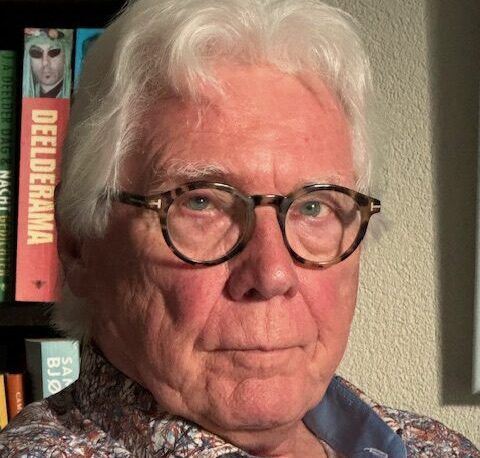

He gave me different eye drops and an ointment. That should clear up the irritation. I was supposed to come back to see him every six months. “It looks good,” the ophthalmologist would always say, to which I invariably replied, “But I can’t see anything with it.” So at some point, I just stopped seeing this doctor.
Painful
Until, in 1958, I finally made another appointment. It was mid-November, and I was able to see a doctor right away. My eye was painful. The ophthalmologist examined my eye with a slit lamp. He immediately arranged for a bed for me in the pediatric ward. There, I had to lie flat right away, without a pillow, and both my eyes were patched. It turned out that all sorts of things had become dislodged inside my eye. By lying flat with both eyes closed, they hoped that everything would settle back into place. In January 1959, I underwent surgery. Afterward, I was told that I would lose all vision in that eye, but that they had managed to save the eye itself. I didn’t need a glass eye—hurray! The fact that I could only see with one eye didn’t really matter. After completing my studies in cultural work at the Social Academy, I began my career as a policy officer in Utrecht. While working there, I took evening classes in psychology at Utrecht University. After a few years, I became director of a consulting firm specializing in construction for the nonprofit sector in Amsterdam, then director of a social services agency in Geleen, and later in Den Bosch. In 2007, I was able to take early retirement because a number of mergers had created a surplus of managers. So losing sight in one eye has never held me back. Although…
I had to take the practical driving test four times before I got my driver’s license. I didn’t have to take up ball sports. But judo is a sport where depth perception isn’t that important. So that became my sport. I started training in Geleen and earned my black belt in judo and jiu-jitsu there. Later, I became president of the judo club. Around the age of sixty, I stopped actively practicing judo due to breathing problems (I’d smoked too much for too long).
Hobbies
I’ve had—and still have—various hobbies: I used to own an antique Volvo and volunteered at the Volvo Classic Association’s parts shop, and I went fly fishing. When it got too cold to fish, I’d make my own artificial flies. “Flies” can mean all sorts of things—worms, larvae, small fish, actual flies, or even mice. Eventually, I gave up this hobby because my eyesight was getting worse and worse. Every time I had to tie a new fly to the line, I found myself needing help from another angler more and more often.
New Activities
Since I’ve always been interested in history, I began to delve into the history of the fortified town of Heusden. I’ve lived here with my wife since 2000, and for the past eight years or so, I’ve been one of the city guides for the Heusden Tourism Bureau. In addition, I serve on the boards of several foundations in Heusden that focus on art and culture in the broadest sense. I also go for a lot of walks with my two dogs: an 11-year-old Heidewachtel and a 2-year-old Spanish mixed-breed dog. We walk for a total of 1.5 to 2 hours each day.
Eye problems, after all
While I was working in Geleen, my vision in my (good) left eye began to deteriorate. It turned out I had cataracts. Fortunately, I didn’t have to wait long, and my ophthalmologist referred me to the Rotterdam Eye Hospital. There, I received a new lens, and the fog cleared instantly! Still, my troubles weren’t over yet. On my way to the Volvo club, my vision suddenly became very blurry. A colleague drove me home, because I couldn’t drive anymore. The retina in my left eye (yes, the good eye) had completely detached. Well, that means you can’t see a thing. Back to the Rotterdam Eye Hospital, where they reattached the retina by injecting gas into my eye and securing the retina with silicone glue. The expectation was that I’d regain 60 to 70% of my vision. Then, after a few weeks, once the gas had cleared from my eye, it turned out I could see 90%!
Now that I could finally see well again in my left eye—with the assurance that I would no longer develop cataracts (a synthetic lens does not cloud over) or suffer a retinal detachment (it is firmly glued in place)—my (blind) right eye started acting up. It was getting paler and smaller and was often inflamed. After consulting with the ophthalmologist in Den Bosch, I decided—six years ago now—to get a prosthesis. That’s when my right eye was removed. It was pretty nerve-wracking, because I thought, “Surely they know the difference between left and right?” For the first few weeks, the eye socket remained swollen and teary. I went to Rotterdam for a second opinion, where they advised fitting a temporary eye socket. The Hague Artificial Eye Laboratory then made my first prosthesis. I looked a lot better right away.
Almost perfect
I’m now on my third prosthesis. This one is practically perfect. People can’t tell that my right eye is “fake.” When I tell them, they always have to look closely to figure out which eye it actually is. All in all, I’m very happy with my prosthesis. I look better, I no longer have any infections, and I have no trouble at all cleaning it regularly.
Strategy
I’ve been seeing with only one eye for 60 years now. I don’t remember what it’s like to see with two eyes. You compensate for the lack of the second eye using all kinds of strategies. Can I perceive depth? Yes, depth also consists of closer and farther, front and back. But it does help when objects move in relation to each other—or when I move myself. Still, pouring a drink works best when you place the neck of the bottle on the rim of the glass.
With just one eye, only about half as much light enters. So I don’t see as well in the dark. But after I had surgery for my cataract, I experienced firsthand that your brain compensates a great deal. You’re only consciously aware of a fraction of the images projected onto your brain via your retina. If you could see everything, you’d go crazy. That’s exactly what happened during the first few days after the surgery. I saw way too much—not a lawn but individual blades of grass, not a sidewalk but individual pavers. And everyone had wrinkles, pimples, and imperfections.
That does make life with only one eye more tiring. So I always make sure to rest. Whenever I get the chance, I take a nap in between. I don’t need to sleep, but I do keep my eyes closed. I had to attend a lot of meetings during my working life, and I quickly learned to sit in the right spot so I could see as many participants as possible. At a rectangular table, I sit at the head. And if someone else is already sitting there? Then I ask if I can sit there and explain why.
Driving isn’t a problem in principle, as long as you’re aware of your limitations. Especially in the dark, judging distances is a bit more difficult, so don’t cross the intersection until you’re sure it’s safe (and don’t let others convince you that it’s okay—just wait calmly until you’re certain yourself). Merging to the right? Only if I’m certain it’s safe to do so (for people who are blind in their left eye, passing other vehicles is more difficult).
Not disabled
I’ve never felt disabled. There are limitations, but I wouldn’t have been a match for Epke Zonderland anyway. I’m too stiff for that.
I regularly read stories from people who have very recently lost an eye. To me, that seems like a traumatic experience, especially later in life. “Now I’m getting an artificial eye.” “What’s going to happen now?” “What can’t I do anymore?” I often try to be reassuring in my responses.
If you’ve lost an eye due to illness or an accident, there’s nothing you can do about it. You’ll just have to learn to live with it. But there are worse things. At least you can still see! You can walk, you can ride a bike, you can read, watch TV, and read the newspaper. And you can learn to work around the challenges by developing strategies. “Sorry, I didn’t see you. I’m blind in that eye.” When you bump into someone again.
And with your modern artificial eye, no one can tell. Yes, you can see it, but you know that—just like everyone around you. But if you don’t say anything, no one else knows or sees it! Jules Deelder wrote a poem for his daughter Ari.
Poem by Jules Deelder
Dear Ari
Don’t be afraid
The world is round
and that’s been the case for a long time
The people are good
People are bad
But they’re all going
the same way
The longer you live
The shorter it takes
You come out of the water
and goes through fire
That’s why, dear Ari
Don’t be afraid
The world keeps turning
and it’ll keep doing that for a long time.
