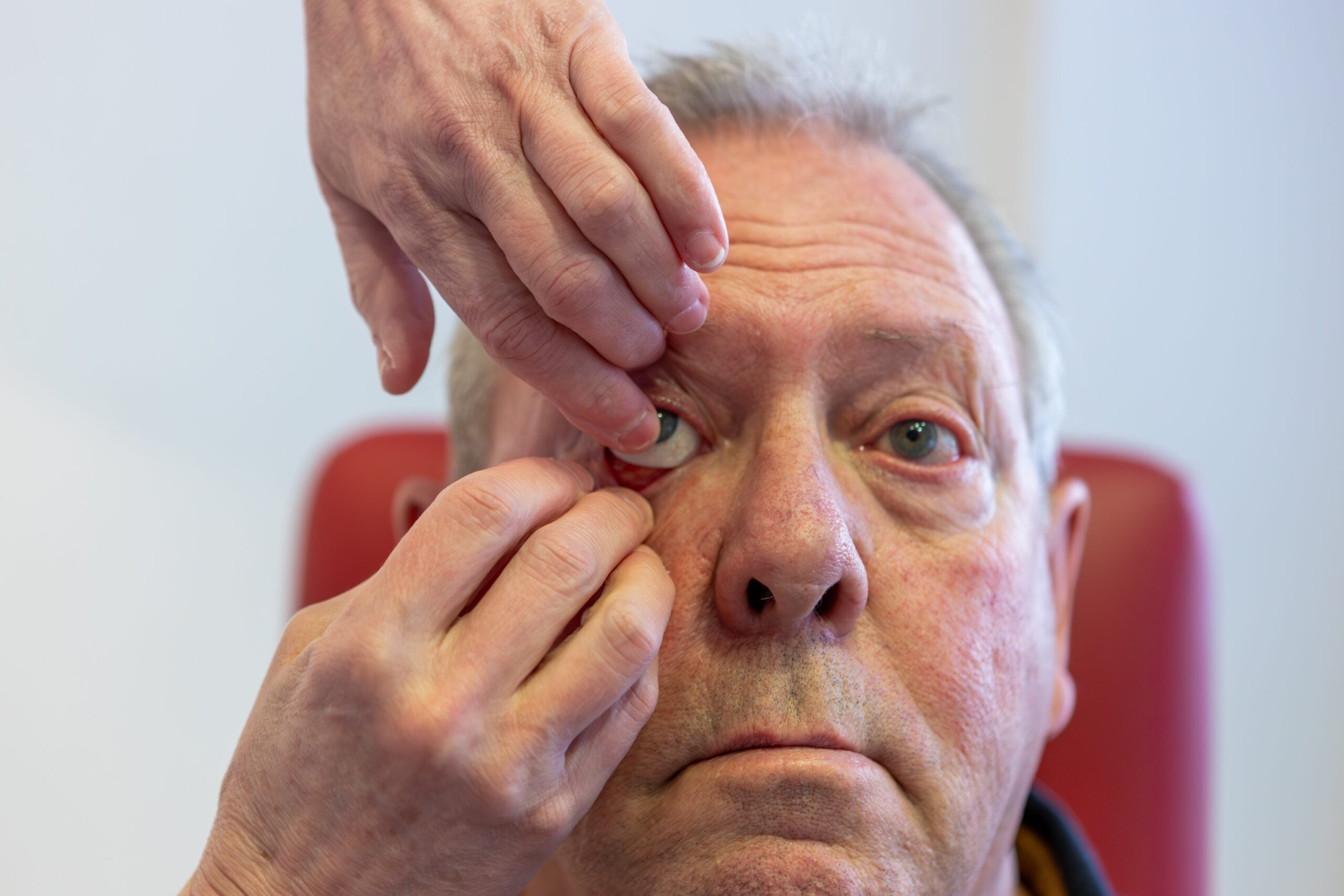
3D-Printed Eye Prosthesis
An article by ophthalmologists Annabel Groot and Dyonne Hartong and ocularist Jelmer Remmers was recently published in the scientific journal *3D Printing and Additive Manufacturing*.

New Publication
This publication demonstrates that it is technically possible to design a 3D eye prosthesis and print it in full color. The publication is a “proof of concept.” Therefore, it has not yet been used on patients. The researchers collaborated with employees at Philips Consumer Lifestyle in Drachten, who printed the created 3D file using one of their most advanced 3D printers.
3D Printing
The eye prosthesis was printed in a single session. This means that no intermediate steps are required between sending the 3D file and post-processing the printed prosthesis (removing support material and polishing). This is an advantage over the conventional method, which requires many steps. Another advantage is that the 3D printing process is reproducible; if necessary, the same prosthesis can be reprinted. After the average two-year lifespan, the same color can be used while the shape is slightly adjusted digitally. It is also possible, for example, to print multiple variants of the same prosthesis in a single print run with different characteristics (color, iris/pupil size, fit, etc.) so that the best option can be selected for the patient on the spot.
The Iris
The shape of a human iris can best be described as half a donut, with the pupil as the hole in the center (in a painted prosthesis, this is a black dot). The sclera (the white of the eye) lies slightly forward of the iris and overlaps it slightly. The iris itself is a muscle and has a fibrous, layered structure in which pigment is distributed in varying amounts throughout the thickness of the iris. This complex structure creates all kinds of light-and-shadow effects that, together with the incident light, largely determine the final color. This effect is particularly noticeable when the light comes from a certain angle. By incorporating as much of the natural anatomy as possible into the 3D prosthesis, the researchers hope to achieve optimal realism. They drew inspiration for this technique from an article by scientists at Disney, who conducted extensive research into methods for giving their digital film characters extremely realistic eyes.
The Method
A standard model of an ocular prosthesis was used in the design. This was digitally divided into a core (sclera and iris), a transparent outer layer (cornea and anterior chamber), and a transparent biocompatible coating. The core features a donut-shaped iris in the center, which was given the color and texture of one of the researchers’ irises (Fig. 2).
The color was captured using a high-resolution macro photograph that was calibrated and post-processed in Photoshop. The combination of the colored core (with texture) and transparent outer layers was printed using a so-called polyjet printer with an accuracy of 0.014 mm. For comparison, a human hair is 0.017–0.181 mm thick. This type of printer can assign a color or material property to each voxel (3D pixel). A detailed explanation of the method can be found in the publication, which is freely available.
What’s next?
Following this proof of concept, the next logical step in the research is a so-called clinical trial, in which patients can be enrolled and custom prostheses can be printed. Previous publications by the same authors have already appeared in the field of digital design of patient-specific models. Researchers in Leuven are also conducting research in this field. By combining this technique (determining the shape) with the technique described in the recent publication (color printing), it is theoretically possible to print custom prostheses and use them on patients.
It is too early to say anything about the aesthetics, durability, color fastness, and comfort of 3D-printed prostheses compared to current, handmade prostheses. These are of high quality and have a high patient satisfaction rate. The conventional manufacturing process was developed around 1940 (for plastic dentures) and has proven to be highly reliable ever since. Now that advanced 3D technology is available in 2021, the researchers believe it is worth exploring these possibilities. Although there are still steps to be taken, this publication may bring the “artificial eye of the future” one step closer.
Special thanks to
Janny Oevering and Winand Slingenbergh of Philips Consumer Lifestyle B.V. Financial support for this publication was provided by the Amsterdam University Fund. The publication is freely available on PubMed and through the publisher’s website. The authors: Annabel Groot, M.A., Dyonne Hartong, Ph.D., and Jelmer Remmers, Amsterdam UMC.